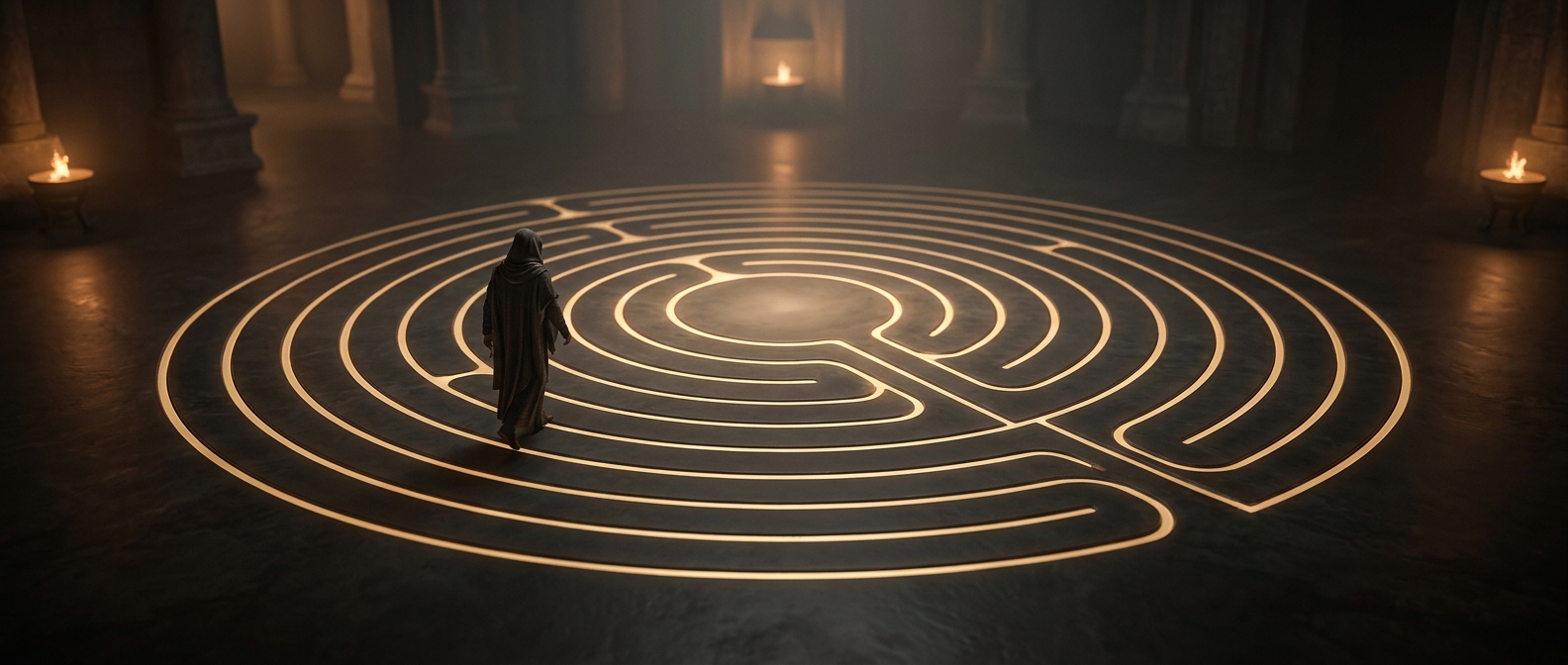
One Route, Wound Into Eleven Circuits
In this classical labyrinth pattern, eleven nested-looking circuits fit inside a single design. The path loops around the center and repeatedly changes direction, but it never splits into competing routes. That makes a labyrinth different from a maze: a maze asks you to choose and recover from wrong turns; this pattern asks you to keep following the one path.
The circuits can look like separate rings from above, yet the route passes between them in a carefully arranged sequence. Each turn carries the walker farther around the design, sometimes seeming to approach the middle and then bending away again. The apparent nearness of the center is part of the route’s winding geometry, not a sign that the walker has taken a wrong turn.
Repetition as a Way to Focus
Because there are no route decisions to solve, attention can shift from navigation to the experience of walking: the pace of each step, the recurring turns, and the changing distance from the center. The repeated motion may feel monotonous, but that sameness is the point. It gives the mind fewer new decisions to chase and a steady pattern to follow.
A labyrinth can therefore serve as a contemplative practice without requiring any supernatural explanation. The walker does not conquer the design by finding a shortcut; the only way to reach the center is to stay with the route. Eleven circuits turn a simple instruction—keep going—into a long, visible journey.