Why magenta has no single wavelength
A rainbow shows colors that correspond to different wavelengths of light: red lies toward one end of the visible spectrum, violet toward the other, with colors such as green in between. Magenta has no place on that continuous spectrum. There is no single wavelength of light that looks magenta.
That does not make magenta imaginary in the everyday sense. It is a real color experience, created when your visual system interprets a particular mix of light.
How the brain fills the gap
The retina has three types of cone cells, each more responsive to a range of wavelengths associated roughly with red, green, or blue light. When red and blue light reach the eye together, they stimulate the long- and short-wavelength cones strongly. But they provide less of the signal associated with green.
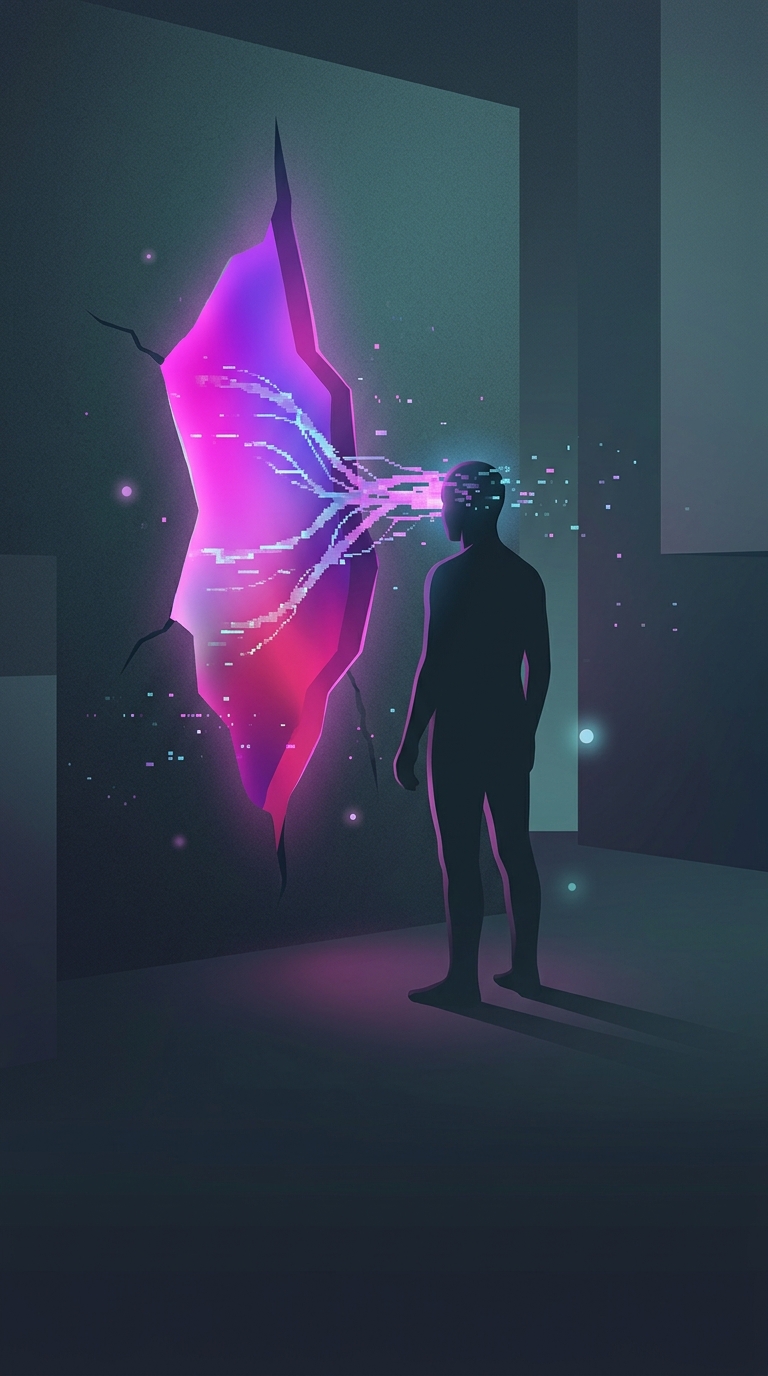
The brain compares these signals rather than reading each wavelength as a separate color label. In this case, it gets a combination that does not match the usual progression from red through green to blue. It resolves that mismatch as magenta—a color that perceptually connects the two ends of the spectrum.
The color is therefore constructed by the brain from the light reaching the eye, not delivered by one uniquely magenta wavelength. Screens exploit the same mechanism: their red, green, and blue pixels mix light to produce colors, including magenta, that the display cannot create as single spectral wavelengths.