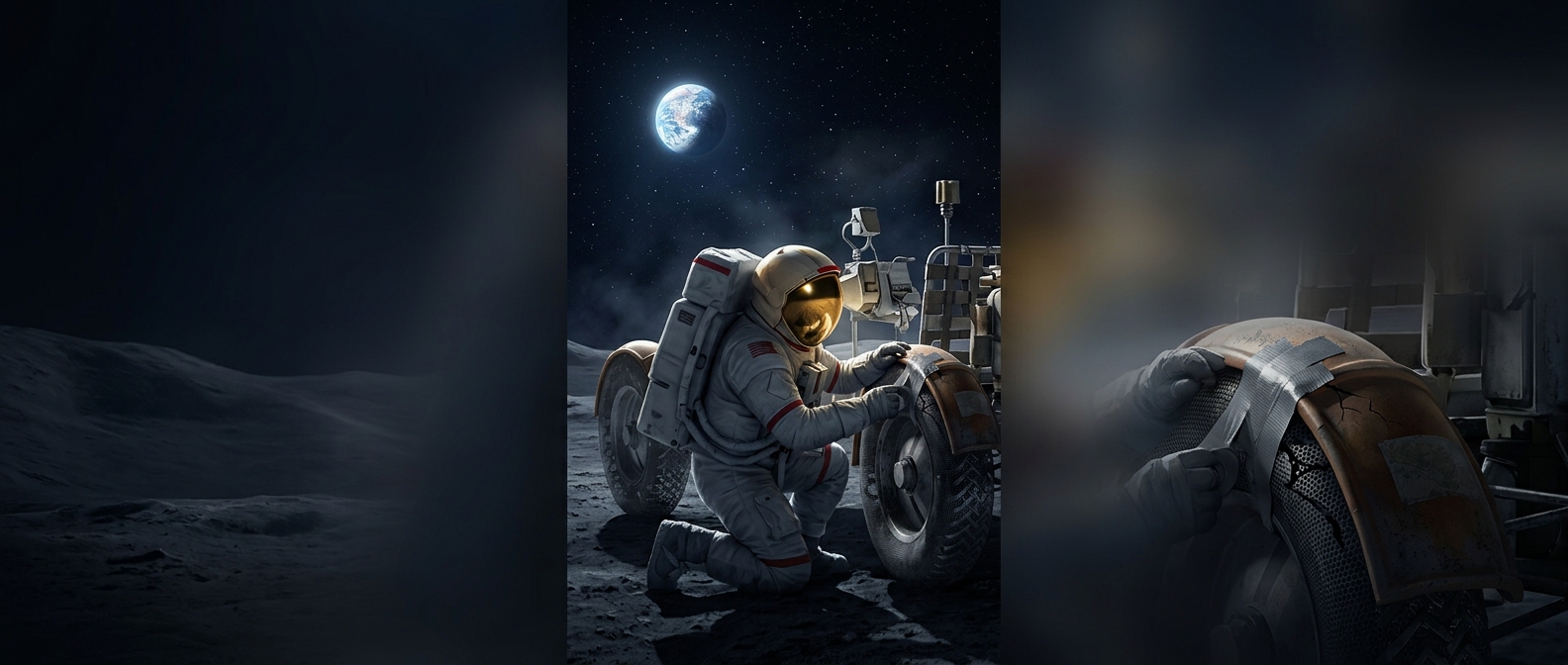
Why a Broken Fender Mattered on the Moon
The lunar rover’s fender was more than a mudguard. Its job was to keep the wheels from flinging sharp, fine lunar soil—called regolith—onto the astronauts and the vehicle. On the Moon, each wheel could send dust arcing outward in long, low-gravity trajectories. Without the fender, that spray could coat spacesuits and equipment, interfere with moving parts, and make the astronauts’ work harder.
Maps Became Part of the Repair
When a fender broke, the astronauts had no replacement part to install. They used folded lunar maps and duct tape to make a makeshift extension over the wheel. The maps supplied a broad, lightweight surface; the tape held the improvised shield in place. It was a practical repair made from materials already on hand, not a restoration to factory condition.
The solution had to work in a place where ordinary repair assumptions did not apply. The astronauts were wearing bulky suits, had limited tools, and could not simply return to a workshop. Even a temporary barrier was valuable if it kept the wheel from spraying as much dust toward the rover and its crew.
A Small Fix With a Long Reach
The repair shows how a minor vehicle failure could become an operational problem on the Moon. A damaged fender threatened to turn every rover movement into a fresh dust plume; a patch made from maps and tape helped preserve the rover’s usefulness for the work still ahead. The striking detail is that a document meant to guide the astronauts across the lunar surface also helped shield them from it.