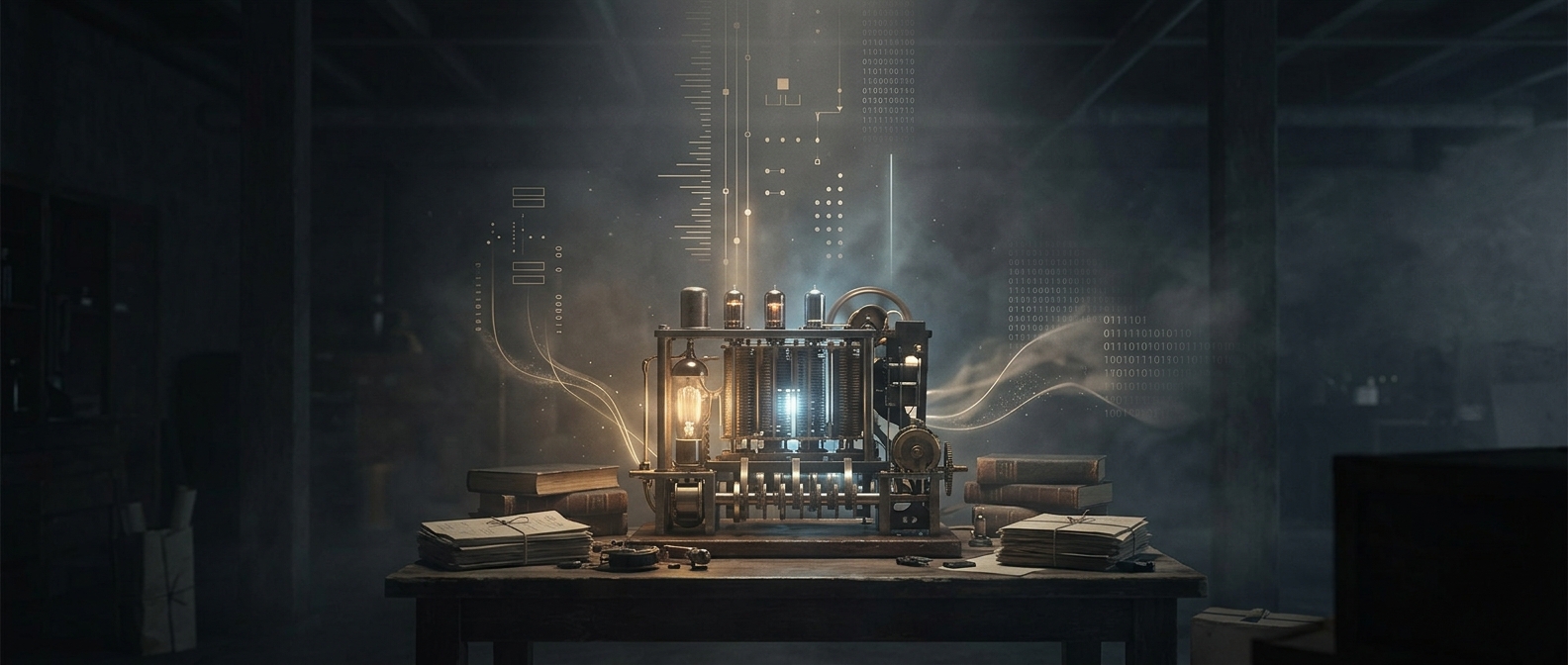
A machine built for one kind of problem
The Iowa device later known as the Atanasoff–Berry Computer was not meant to run a changing sequence of instructions. It was built to help solve systems of linear equations—sets of relationships whose unknown values must be found together. Its purpose was narrow, but its design joined electronic calculation with a way to hold numbers while a computation was under way.
That distinction matters: a computer can perform calculations without being programmable in the modern sense. The machine’s operations were fixed by its construction, rather than directed by a stored program that could tell it to perform different tasks.
How the electronics and memory worked together
Vacuum tubes—glass components that control electrical current—handled the arithmetic. For memory, capacitors, which store electrical charge, carried numerical information on a rotating drum. As the drum turned, stored values could come around again to be used in later steps.
This arrangement offered a practical way to keep numbers available to the calculation, but it was not the flexible, instantly addressable memory familiar in later computers. The machine’s parts and layout shaped what it could do: it was a specialized calculator, not an all-purpose machine awaiting new software.
Why it disappeared from view
After its work was done, the apparatus was dismantled for parts. With no intact machine to demonstrate, its role in the development of computing was easy to overlook. It returned to public attention decades later through a 1973 lawsuit concerning computer patents. The legal dispute made the old Iowa machine relevant again—not because it had suddenly become versatile, but because its early combination of electronic arithmetic and stored numerical information mattered to the history being argued over.
Its fate is a reminder that technological importance does not guarantee preservation: a machine can be taken apart for useful components before anyone agrees on what its design means.