BioShock Turns a Boss Fight Into a Test of Control
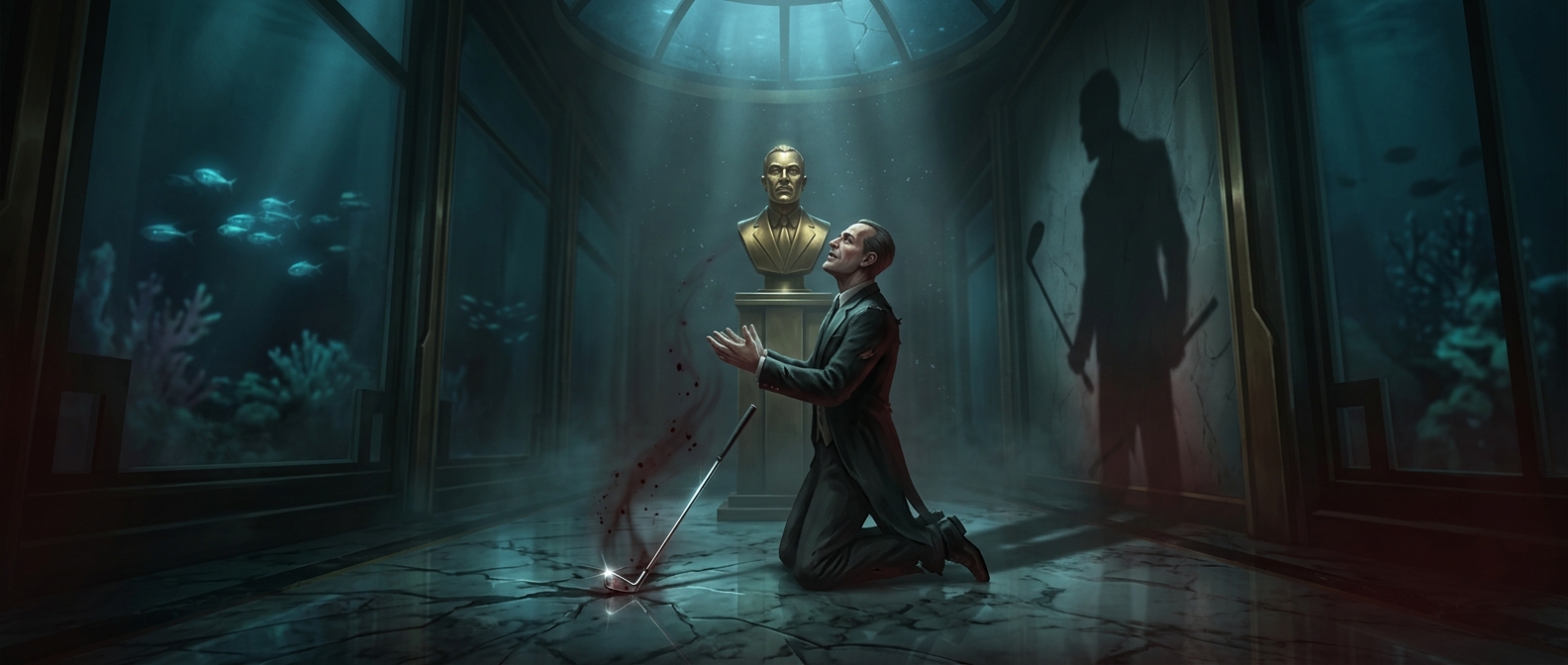
Most games teach players that a powerful enemy must be defeated through combat. BioShock instead brings its central antagonist, Andrew Ryan, face-to-face with the player character and makes the expected fight impossible: Ryan does not defend himself. The player is made to carry out the killing with a golf club, a blunt object that makes the act feel less like a triumphant duel than a grim execution.
The Player’s Actions Become the Point
The scene matters because BioShock has spent much of the game giving the player commands to follow. Ryan recognizes that pattern and uses it to challenge the player’s sense of agency—the feeling that choices are genuinely one’s own. The killing is not simply something the protagonist witnesses; the game requires the player to perform it, even though Ryan has stopped resisting.
That turns a familiar game convention into part of the story. Players are accustomed to obeying objectives and pressing the prompted button to advance. Here, that obedience is exposed as the subject of the scene: the player’s hands carry out an action while the story asks who, exactly, is choosing.
A Violent Ending to an Ideological Conflict
Ryan’s death therefore does more than remove an antagonist. His refusal to fight makes the killing a final demonstration of the conflict between his beliefs about individual choice and the control exerted over the protagonist. The blunt, deliberate violence denies the player the distance of a conventional action sequence. Instead of winning a battle, the player has to sit with an action the game has made unavoidable—and with the uncomfortable gap between performing a choice and freely making one.