How a Cable Turns a Gorge Into a Route
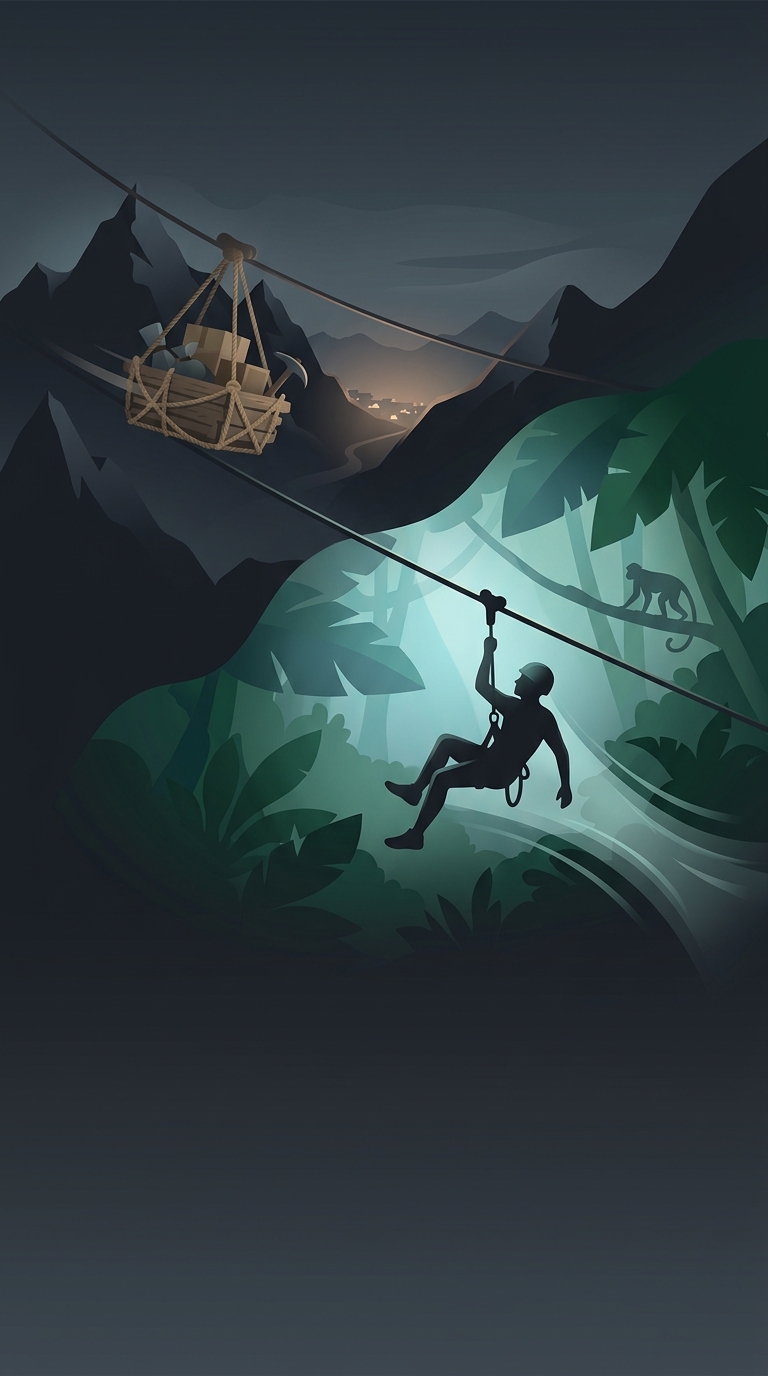
A cargo line works by making a cable the path between two points that would otherwise be difficult to connect. The load is attached to a rolling trolley, whose wheels grip or ride on the cable. If the far end is lower, gravity pulls the trolley downhill, carrying the cargo across without requiring a path along the ground.
The height difference is crucial: a line that is nearly level may not move a heavy load reliably, while a steep line can send it across too quickly. Operators therefore have to balance slope, cargo weight, cable strength, and the method used to slow or stop the trolley. The cable also sags under load, so its anchors and supports must withstand substantial forces—not just the weight of the cargo, but the pull created by a tensioned line.
A Shortcut With Limits
The system avoids obstacles rather than removing them. A gorge, river, or steep slope can remain untouched while goods travel overhead, but the cargo still has to be loaded at one end and retrieved at the other. Moving it back uphill may require a separate return line, a powered winch, or manual work; gravity alone only helps when the route descends.
That tradeoff made cable transport useful where building a road or carrying every load over rough ground was impractical. It could move supplies across a natural barrier with relatively little infrastructure on the ground. The same simple arrangement—an elevated cable, a trolley, and a carefully chosen route—turns a difficult detour into a direct crossing, while leaving the terrain below largely unchanged.