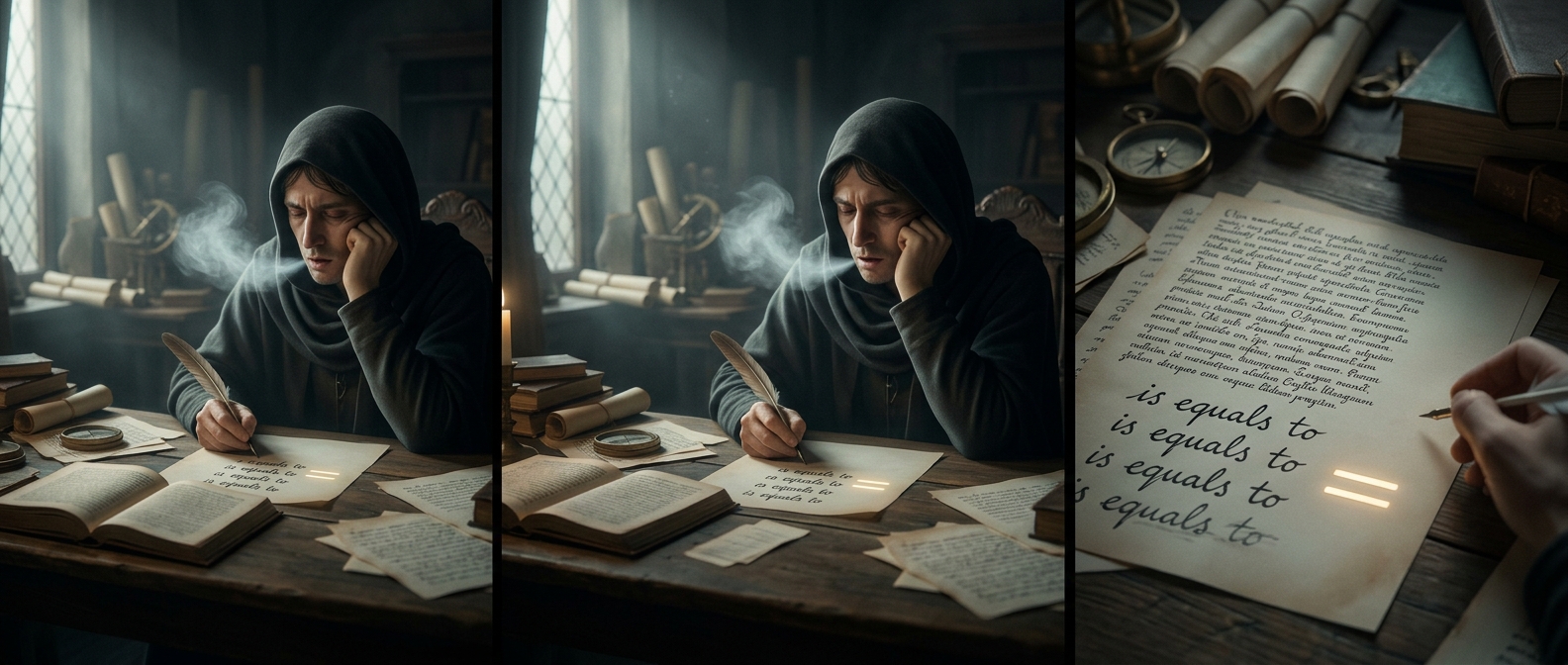
A long phrase became two lines
Before “=” was available, a mathematician comparing two quantities had to write out a phrase such as “is equal to” or use an abbreviation. In a worked calculation, that phrase could recur at every step. Robert Recorde’s compact mark made the relationship visible without repeatedly writing the words—a small change that also meant less writing by hand.
Recorde introduced the sign in his 1557 book The Whetstone of Witte. He was explaining how to show that two expressions had the same value, and chose two parallel lines as a fitting symbol: nothing, he reasoned, could be more equal than two parallel lines.
A useful sign still needed time
The symbol did not instantly become the universal notation it is now. Mathematical writers continued to use words and other marks, and conventions took time to settle. But two simple strokes were easy to recognize and reproduce, and the sign eventually became standard in arithmetic and algebra.
That practical design is part of its staying power. The equals sign does more than save a writer’s wrist: it lets a reader scan an equation and see, at a glance, which quantities are being asserted to match.