How Small Mirrors Corrected Hubble’s Blurred View
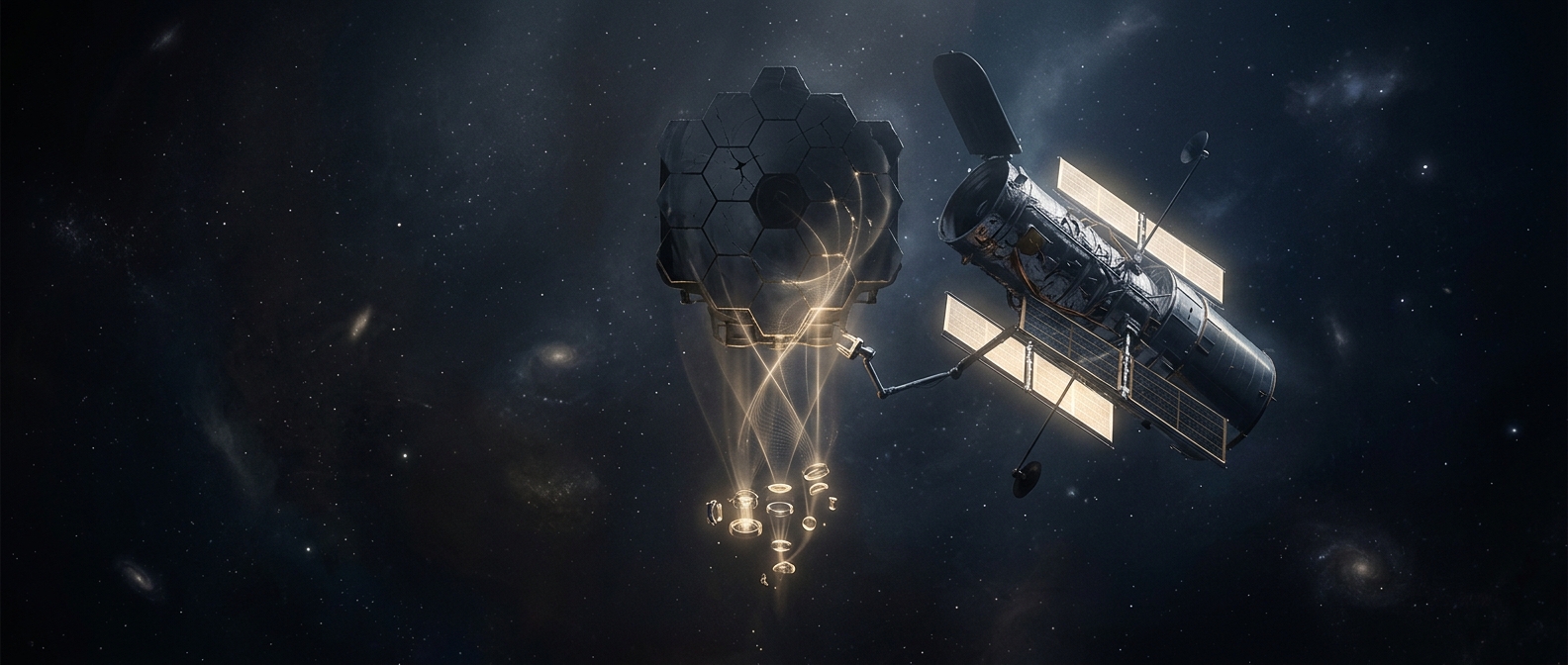
Hubble’s main mirror gathered light, but its edge had been shaped incorrectly. As a result, light from a single distant object did not come to a clean focus: some rays landed in the wrong place, smearing the image. The mirror was still useful; the problem was that the light it reflected needed another correction before it reached the cameras and other instruments.
Astronauts did not reshape or replace the large mirror. Instead, they installed corrective optics that intercepted the reflected light and redirected it. Their small mirrors were precisely shaped so they could compensate for the error in the main mirror’s focusing. In effect, the added optics introduced an opposite error, bringing the rays back into alignment.
A Repair Built Around the Telescope
This approach turned Hubble’s modular design into a practical advantage. The telescope’s instruments could be reached and replaced during servicing missions, so the fix could be placed in the path between the primary mirror and the equipment receiving its light. The corrective system, known as COSTAR, served several instruments; a replacement camera received its own correction as part of its design.
That distinction matters: Hubble’s original mirror remained in place, flawed shape and all. The repair worked by changing what happened to its light afterward. Once corrected light reached the instruments, they could form sharp images rather than trying to make sense of a blur. A small set of carefully made mirrors could therefore restore the performance of a much larger telescope without changing its most prominent piece of glass.