Why Early Thermometers Used Colored Alcohol
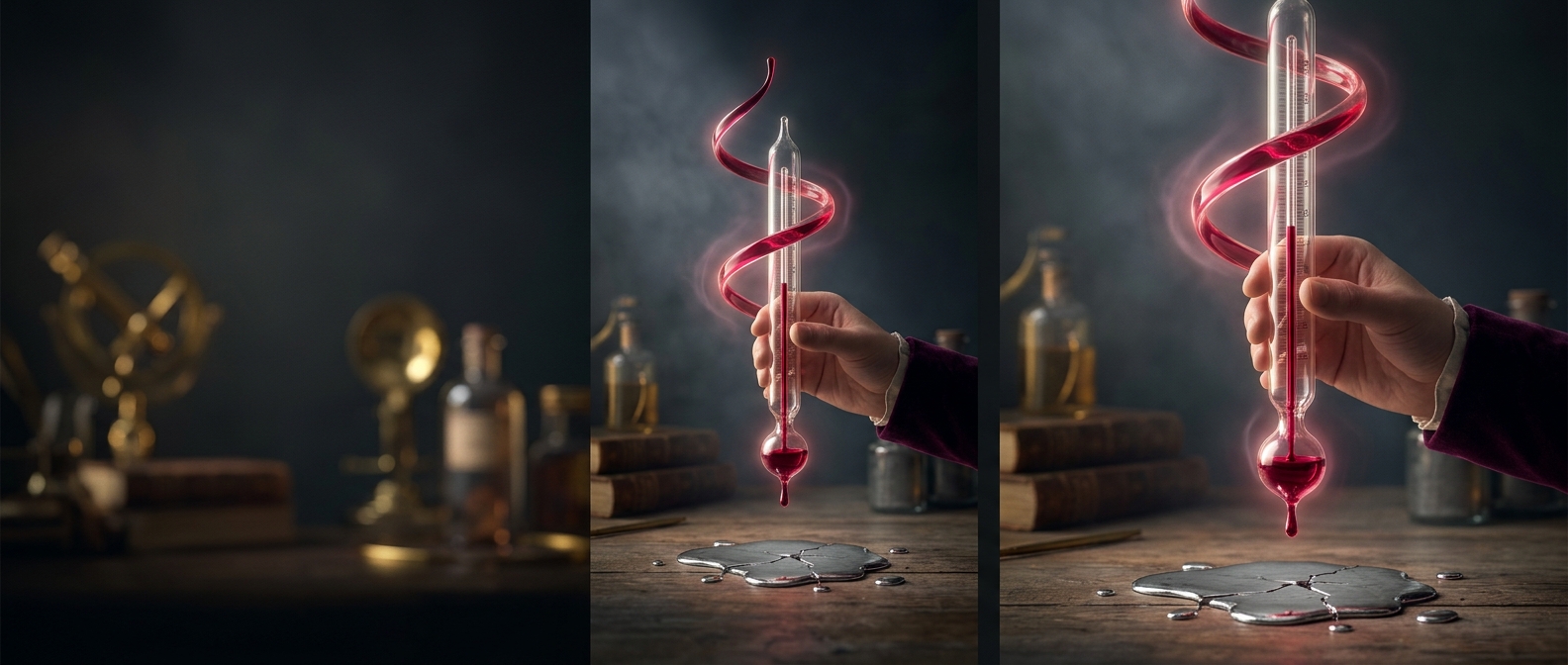
A liquid-in-glass thermometer turns temperature into a visible movement. Its narrow tube connects to a small glass bulb; when the liquid warms, it expands and climbs the tube. As it cools, it contracts and falls. The markings beside the tube translate that movement into a temperature reading.
Alcohol was a practical liquid for early instruments, especially where cold mattered. It stays liquid at temperatures far below water’s freezing point, so an alcohol thermometer can register severe cold that would freeze water in the tube. The alcohol itself is nearly clear, however, so makers tinted it to make the thin column easier to see against the glass.
The Liquid Shaped the Instrument’s Uses
Alcohol expands noticeably as it warms, making its movement readable in a fine tube. But it also has limits: it boils at a comparatively low temperature, so it is unsuitable for measuring very high heat. Its expansion is also less uniform than mercury’s over a wide range, which can make a scale harder to calibrate consistently.
Mercury later became common in many thermometers because it stays liquid across a broad range and forms a sharply defined column in glass. Alcohol remained useful where low-temperature readings were important. The choice of liquid was not just a matter of convenience: it determined which temperatures an instrument could measure—and how clearly its reading appeared.