How glass became a light guide
A stream of water can carry a beam of light around a bend because light does not always pass out through the side of a material. When it meets the boundary between water and air at a shallow enough angle, it reflects back inside. This repeated reflection—called total internal reflection—keeps the light traveling along the stream instead of escaping.
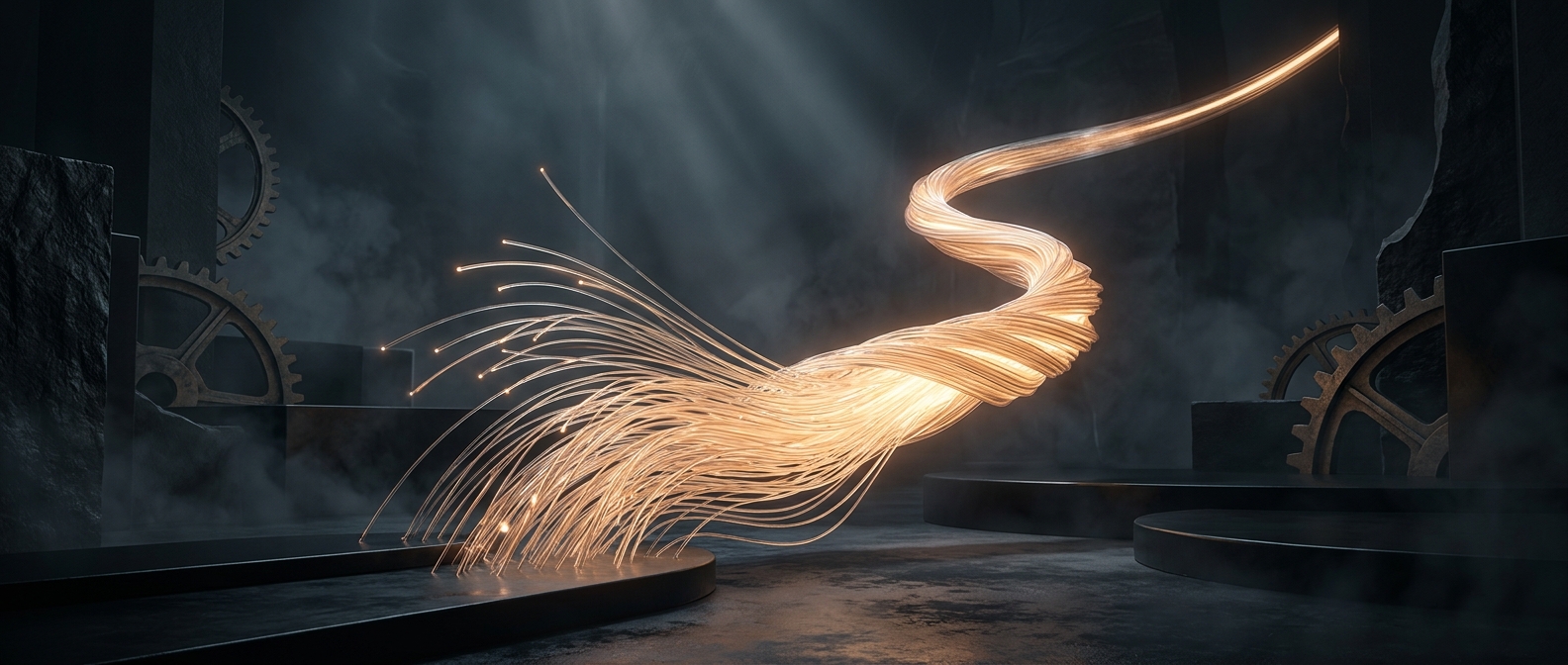
Glass fibers use the same principle in a much narrower, more controllable form. Glass can be drawn into long, thin strands, and light entering one end can bounce along the strand’s interior even as the fiber curves. A cable can bundle many such fibers, giving each light signal its own path.
From demonstration to useful cable
The water-and-light demonstrations showed that a curved path could guide light, but a visible stream was not a practical communications line. Glass fibers offered a solid route that could be bundled and protected. Early fibers were limited by how much light they lost: tiny imperfections and impurities in glass scattered or absorbed light, so a signal weakened as it traveled.
Making fiber optics useful therefore depended not just on drawing glass into strands, but on improving the material and controlling the boundary around each strand. In modern optical fiber, a surrounding glass layer, called the cladding, is designed so light stays in the central core. The old demonstration supplied the key physical idea; better glass and fiber construction turned that idea into a workable way to send light through a cable.