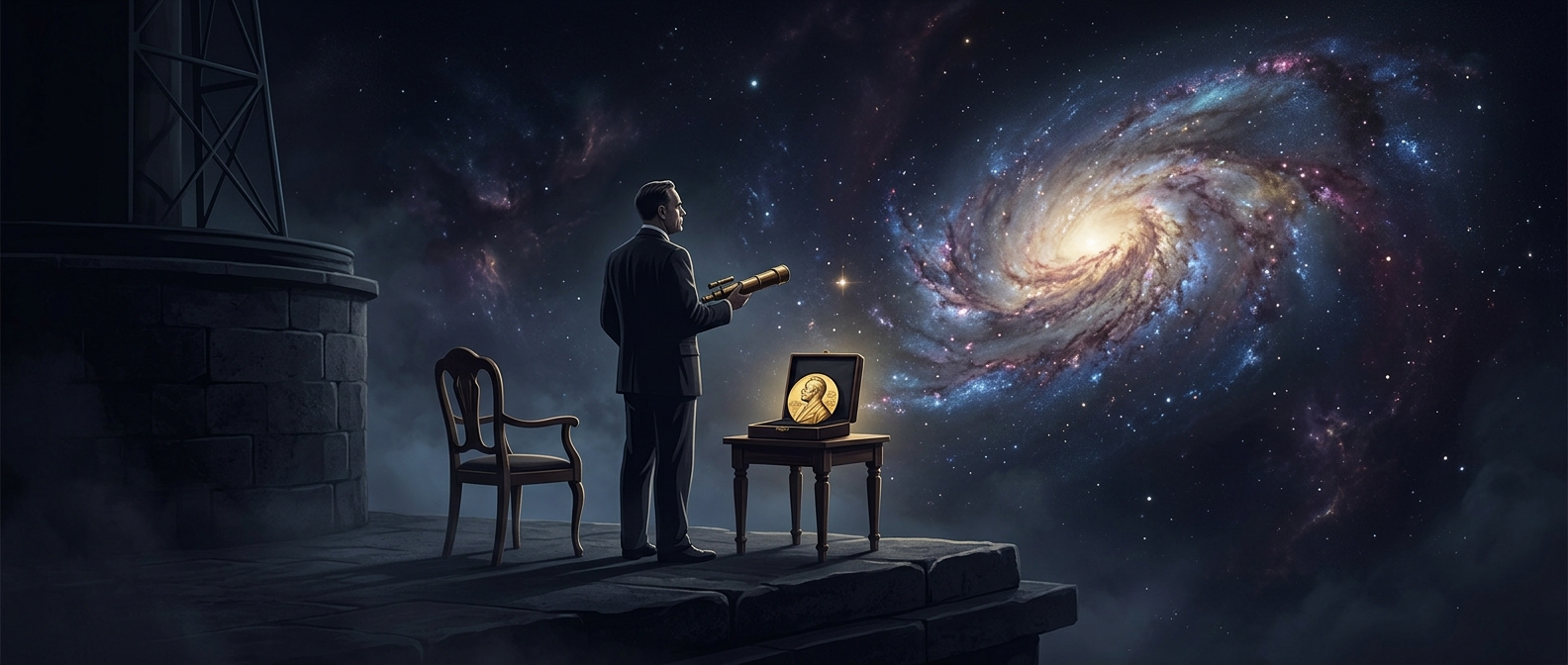
Astronomy had no Nobel category of its own
The Nobel Prizes include physics, chemistry, medicine, literature, peace, and economics—but not astronomy. Edwin Hubble’s discoveries therefore had to qualify for the physics prize, not a separate award for astronomy.
That distinction mattered in the early 20th century. Astronomers often inferred the universe’s properties from observations of distant objects, while Nobel judges tended to view astronomy as a field apart from experimental physics. A finding could transform scientists’ picture of the cosmos and still be hard to fit within the committee’s idea of prizeworthy physics.
Hubble’s evidence changed the picture of the universe
Hubble studied galaxies beyond the Milky Way and measured how their light was shifted toward redder wavelengths. That shift revealed that the galaxies were moving away; comparing their distances with their apparent speeds showed a pattern: the farther away a galaxy was, the faster it receded. The result became central evidence that the universe is expanding.
The work depended on painstaking observation and interpretation, not a single laboratory experiment. Its significance was immense, but the Nobel system’s categories and judgments did not automatically treat a major astronomical result as a physics breakthrough eligible for recognition.
The timing closed the door
Hubble died in 1953, before receiving a Nobel Prize. His case is often summarized as astronomy being excluded from physics, but the boundary was not a simple permanent ban: later prizes have recognized discoveries about the universe when committees judged them to be physics. Hubble’s story instead shows how a prize category can shape recognition—the universe could be expanding, yet the discovery still had to pass through a narrow institutional definition of physics.