A sentence that changed the setting, not the work
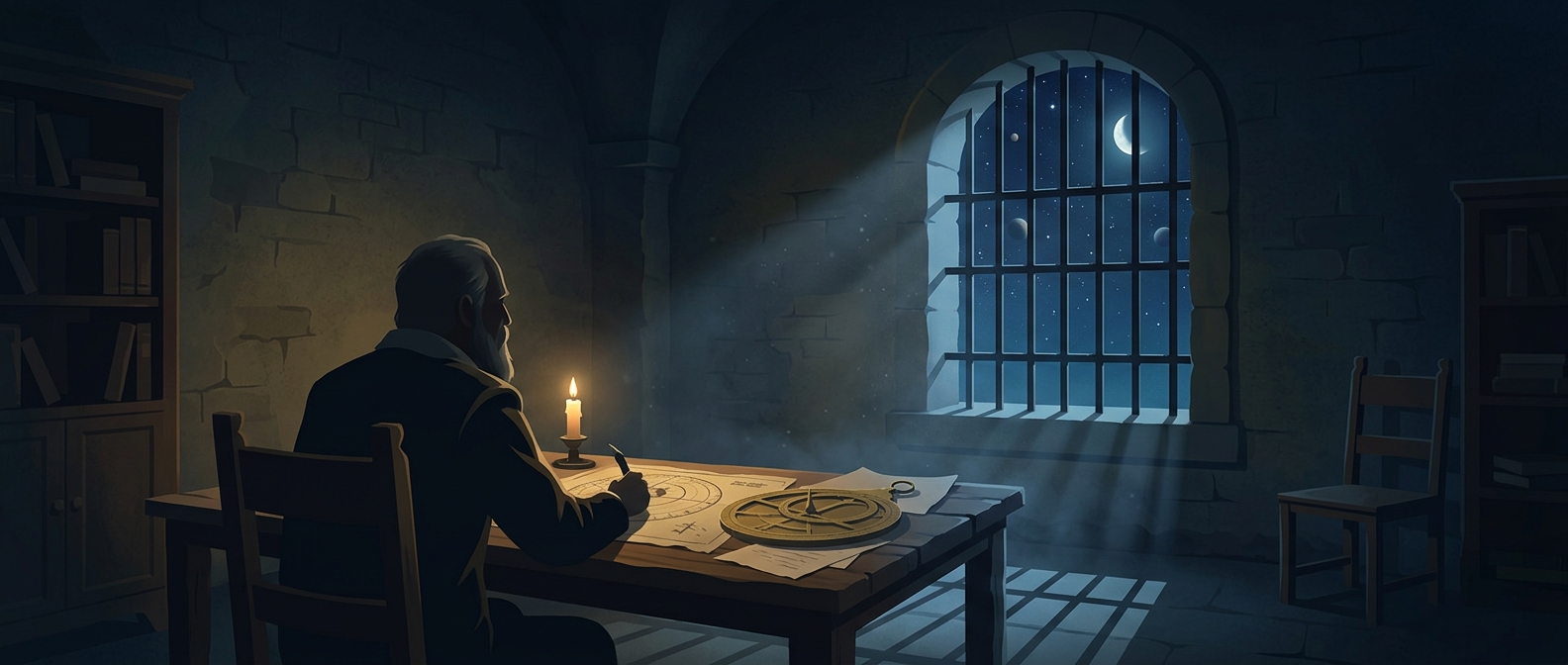
In 1633, the Roman Inquisition judged Galileo “vehemently suspected of heresy” over his defense of the Sun-centered system. He was ordered to abjure—that is, formally renounce—the view, and his book presenting the debate was prohibited. His sentence of imprisonment was soon commuted to house arrest: first in Siena, then at his villa in Arcetri, outside Florence.
The restriction mattered. Galileo could no longer travel and work openly as before, and his movements were subject to Church authority. But confinement did not prevent him from writing or exchanging ideas with visitors and correspondents.
From confinement came a major scientific work
At Arcetri, Galileo developed a book about motion and the strength of materials, topics distinct from the dispute over Earth’s motion. The work drew on decades of investigation into how objects fall and how moving bodies behave. By examining those questions through careful reasoning and experiments, he helped lay groundwork for the mathematical study of motion.
The manuscript reached a printer in Leiden, in the Dutch Republic, and appeared in 1638 as Discourses and Mathematical Demonstrations Relating to Two New Sciences. Publication abroad allowed the work to circulate despite the restrictions imposed in Italy.
By then, Galileo had gone blind. His final years were therefore marked by both severe physical loss and continued intellectual labor. The lasting consequence of the sentence was not that his ideas vanished, but that his work continued from a villa—and, for a major book, had to reach readers through a press beyond the authorities’ reach.