Why Saturn Looked So Strange Through Early Telescopes
In the mid-17th century, Saturn was a puzzle. Seen through the small, imperfect telescopes then available, the planet seemed to have odd shapes beside it. Galileo had described it as having “ears”: in some observations, Saturn appeared to have two lumps attached to its sides. As the planet changed appearance, those shapes seemed to vanish or alter, making a straightforward explanation difficult.
The Lens Was Part of the Problem
Christiaan Huygens worked to improve what observers could actually see. He ground and polished his own glass lenses, aiming for a sharper image. A telescope’s lens bends incoming light to form an image; flaws or imperfect curvature can blur that image, especially when the target is small and distant. Better optics could make Saturn’s changing outline easier to interpret—not by changing the planet, but by reducing the instrument’s contribution to the confusion.
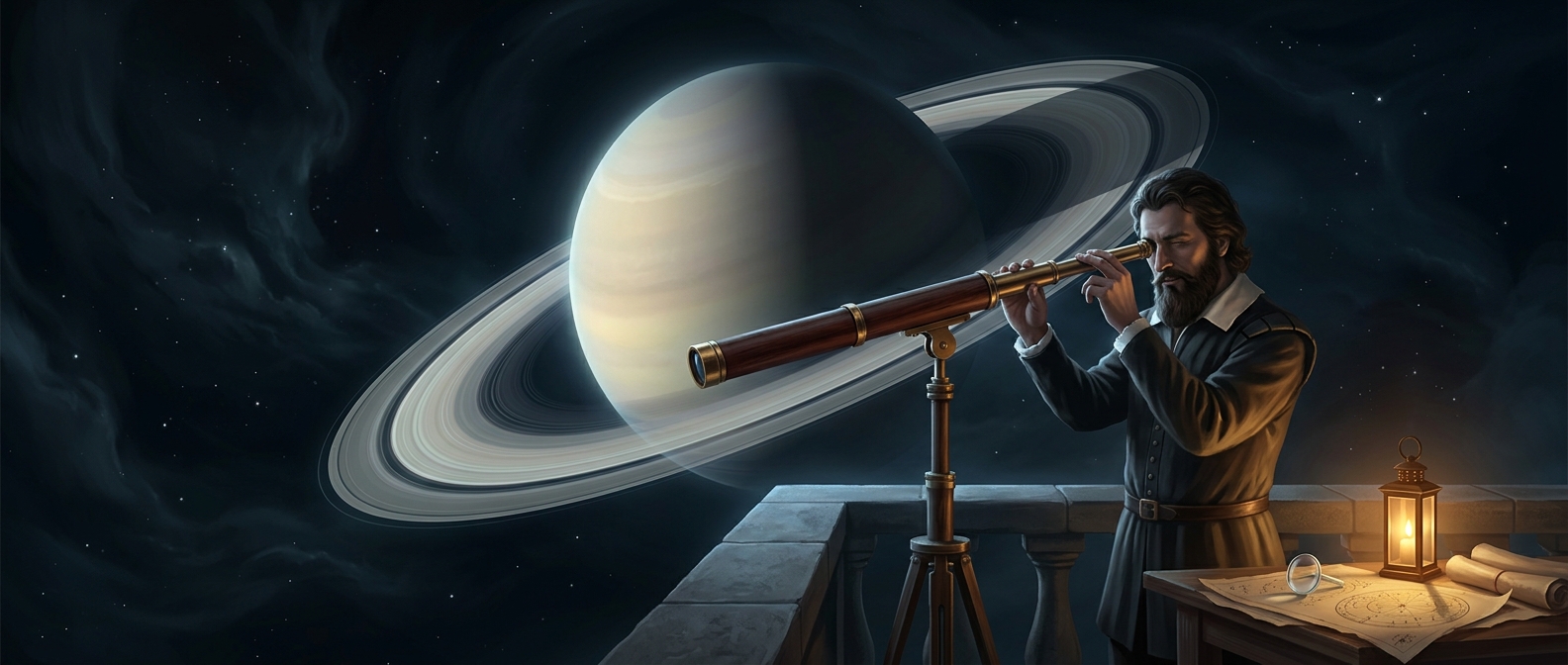
Huygens also used a long telescope, which helped him magnify Saturn while limiting some of the distortion caused by the lenses of the time. As he compared observations, he concluded that the strange features were not separate bodies traveling beside the planet. They were a thin, broad ring surrounding Saturn, appearing differently as its orientation to Earth changed.
A New Explanation for a Changing View
The ring’s changing appearance supplied the missing logic: when viewed nearly edge-on, it could become difficult to see, while at other angles it looked like prominent shapes flanking the planet. Huygens published his ring explanation in 1659. His achievement joined patient observation to practical instrument-making: the improvement was not just a clearer picture, but a way to tell which parts of the picture belonged to Saturn and which came from the telescope.