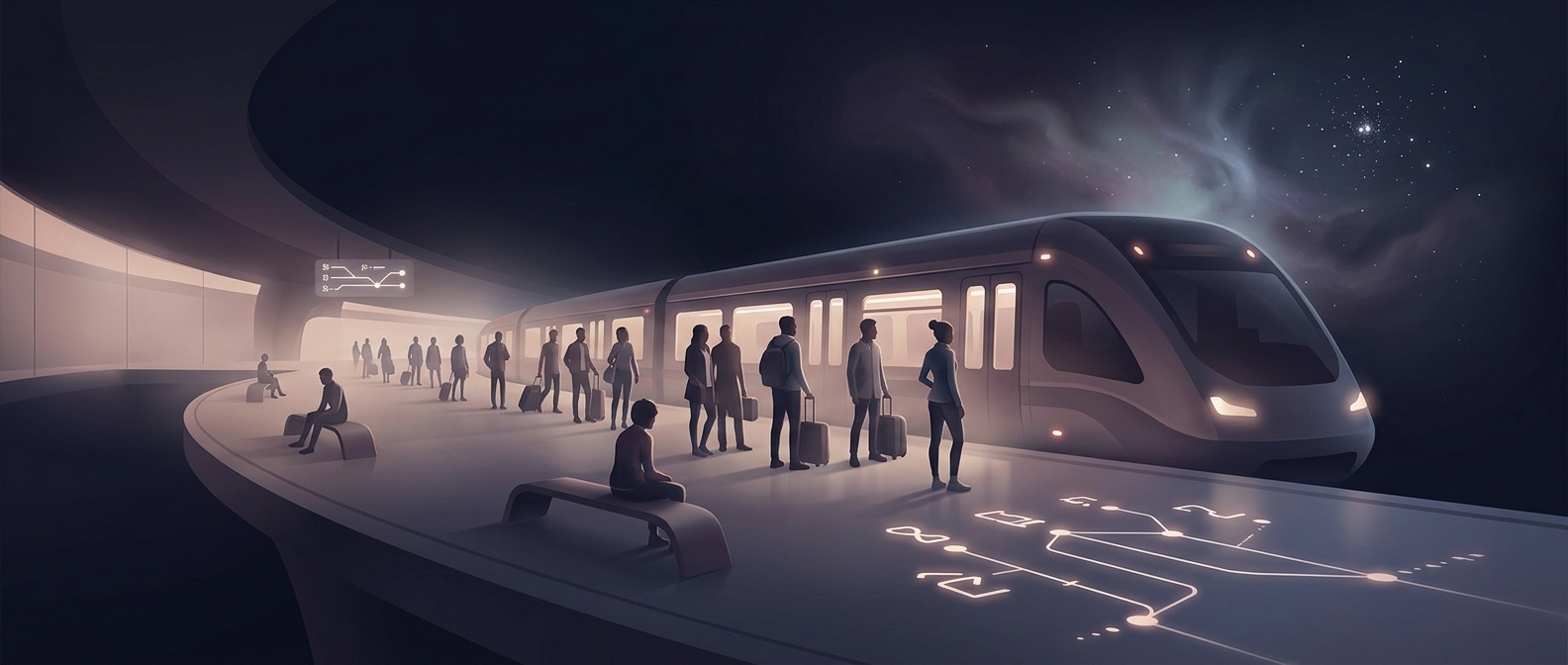
A Subway Car’s Familiar Rules, in an Unfamiliar Place
Overhead straps, crowded standing passengers, and a shared sideways sway are instant shorthand for public transit. Put those details in a spacecraft and the scene becomes readable at a glance: this is not a heroic expedition, but an ordinary commute that happens to cross space. The joke—and much of the charm—comes from treating the extraordinary as routine.
That familiarity matters because space travel is otherwise hard to picture as everyday life. A subway car gives viewers a ready-made social setting: people stand close together, hold on, and ride out the motion. The straps also make the scene feel physically and emotionally recognizable, even when its setting is fantastical.
What Zero Gravity Would Change
In true weightlessness, passengers would not be pressed toward a floor, and loose straps would not hang neatly overhead. A vehicle’s turn or acceleration could move bodies relative to the cabin, but the familiar pendulum-like sway of commuters depends on gravity pulling them down. So the scene borrows the visual grammar of a terrestrial train rather than depicting the full mechanics of weightlessness.
That mismatch is useful storytelling. The straps tell us how to read the image before we stop to ask whether they would behave that way in orbit. If a story wanted the same commute to follow realistic physics, it would need to establish some source of artificial gravity or show passengers secured in a different way. Here, the ordinary transit cues do the quicker work: they make an intergalactic ride feel like one more crowded trip home.