Why a Dropped Tool Bag Kept Circling Earth
A spacewalker’s instinctive picture of “down” does not work the same way in orbit. The International Space Station and everything inside it are moving sideways around Earth at tremendous speed. Gravity is still pulling them toward the planet, but that forward motion carries them past the ground as they fall. The result is a continuous curved path around Earth.
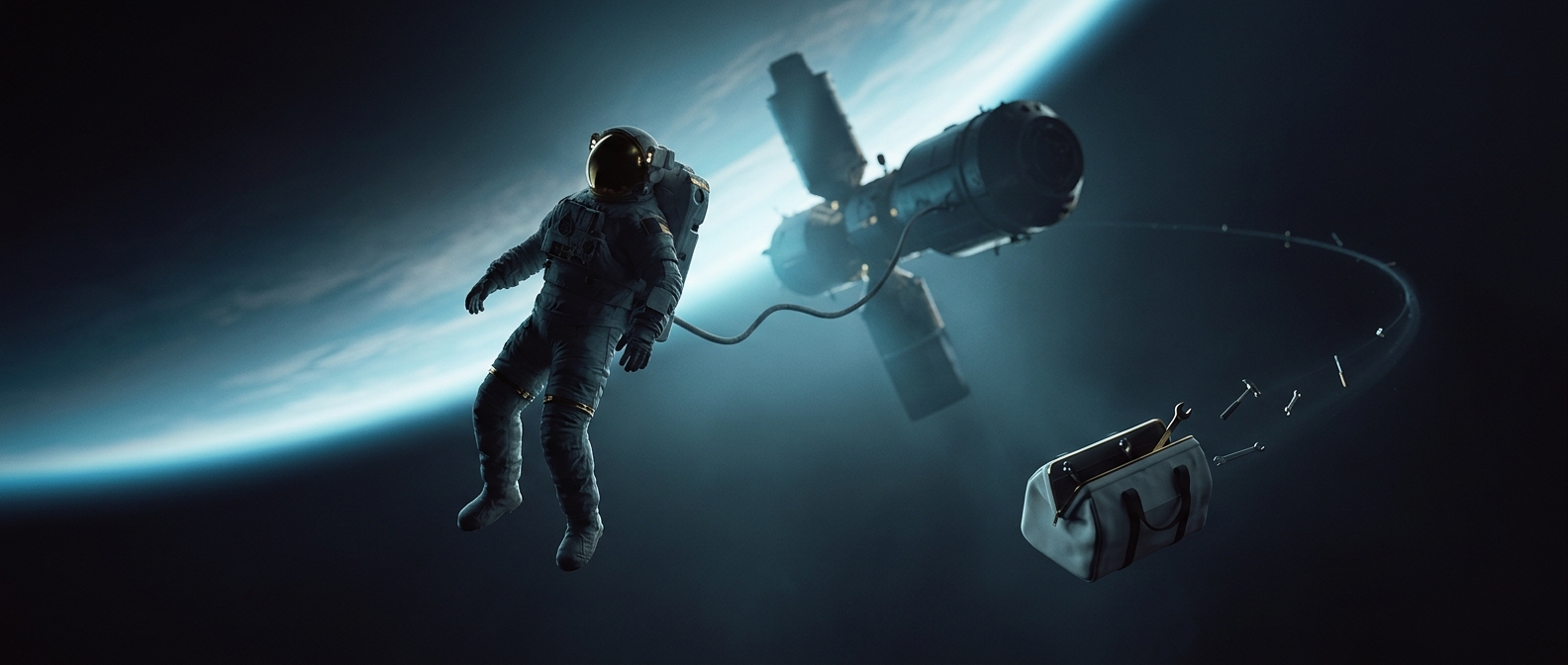
When Heidemarie Stefanyshyn-Piper’s tool bag slipped away during a 2008 spacewalk, it kept the station’s orbital motion. It did not need an engine to stay aloft: like the station, it was already moving fast enough sideways for its fall to curve around the planet rather than take it straight down.
A Small Release Can Change the Route
The bag did not remain neatly beside the station. A push, however slight, can give a released object a slightly different path. In orbit, that difference accumulates: the object may travel at a different altitude or speed, and gradually move ahead of or behind the spacecraft it left.
Orbit is therefore not a fixed track like a railway line. It is a balance between an object’s forward motion and Earth’s gravity, with its particular speed and direction determining the route. A tool bag and a space station can both orbit Earth while following separate paths.
Why It Could Not Stay Up Forever
Low Earth orbit is not completely empty. A thin trace of atmosphere creates drag, which slowly robs an object of orbital energy. As its orbit shrinks, it encounters denser air and loses energy more quickly, eventually falling into the atmosphere. The station periodically receives boosts to counter this effect; an unpowered tool bag does not.
So the bag’s escape was not a flight away from Earth. It was a temporary solo orbit—and a vivid demonstration that in space, letting go means sharing your motion with an object that can keep going around the planet.