How Apollo’s tiny computer stayed on course
The Apollo Guidance Computer (AGC) did not steer by holding a detailed picture of the spacecraft in memory. Instead, it repeatedly read measurements from the spacecraft’s instruments, updated its estimate of position and motion, and calculated the small corrections needed to follow a planned path. Astronauts used its display and keyboard to call up procedures and enter commands; the computer handled time-critical calculations and guidance tasks.
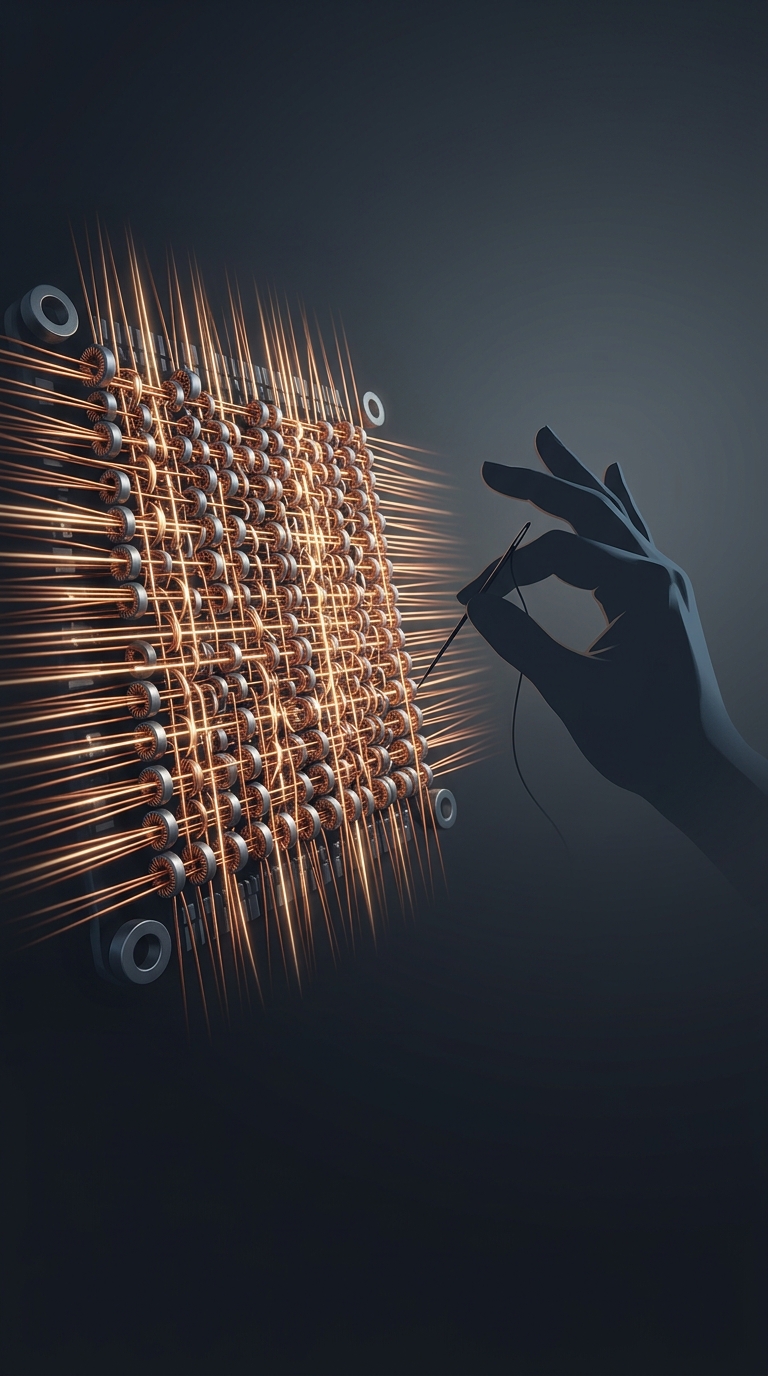
That design made memory precious. The AGC used two kinds: erasable memory for changing information, such as current measurements and calculations, and fixed memory for its instructions. The fixed memory was made with core rope: wires threaded through tiny magnetic cores in patterns that encoded the program. Changing the software could therefore require changing how the wires were woven, not simply rewriting a file.
What happened when it ran out of time
The challenge was not only fitting instructions into memory. The computer also had to finish urgent work on schedule while receiving data from multiple sources. Its software organized tasks by priority, so guidance and control work could take precedence over less urgent jobs.
That system mattered during Apollo 11’s lunar landing. When the computer reported 1201 and 1202 alarms, it was signaling that too many tasks were competing for processing time. The software restarted lower-priority work while preserving the essential guidance tasks, allowing the descent to continue. The alarms were a warning about workload—not proof that the computer had failed outright.
Apollo’s solution was to make a small computer behave reliably through careful programming, scheduling, and a tightly defined job. Its limited resources shaped the software as much as the spacecraft’s hardware did.