Why the Dot Pulls a Cat Into the Chase
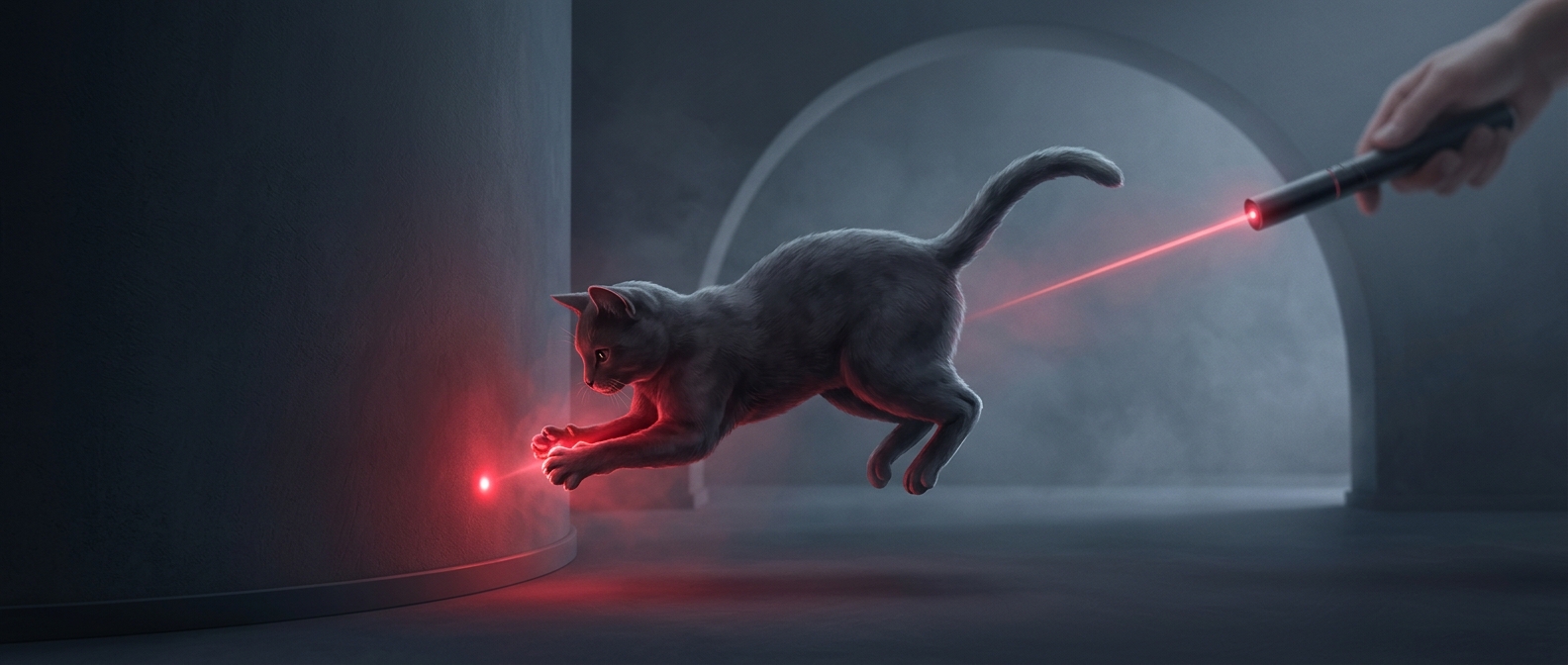
A laser pointer’s beam is usually hard to see in the air; the bright dot appears when the light lands on a surface and reflects toward the cat. Move that spot, and it darts like small prey. Cats are especially responsive to quick, irregular movement, so a dot skimming around a corner can prompt stalking, pouncing, and sudden changes of direction.
The chase, however, leaves out the part that makes hunting a complete sequence. With a toy mouse, a cat can grab, bite, and feel that its action has stopped the prey. A light spot has no body to hold and no weight to pin down. It vanishes when the pointer moves or switches off, so the cat gets pursuit without the tactile payoff of a catch.
Give the Chase an Ending
That mismatch does not mean every cat will become upset, but repeated play with nothing tangible to capture may be unsatisfying. A simple way to complete the game is to finish by directing the dot toward a physical toy, then let the cat catch and handle that toy. A treat can also provide a clear reward after the chase.
The key difference is not how fast the dot moves. It is whether the cat gets to finish the sequence with something it can actually catch.