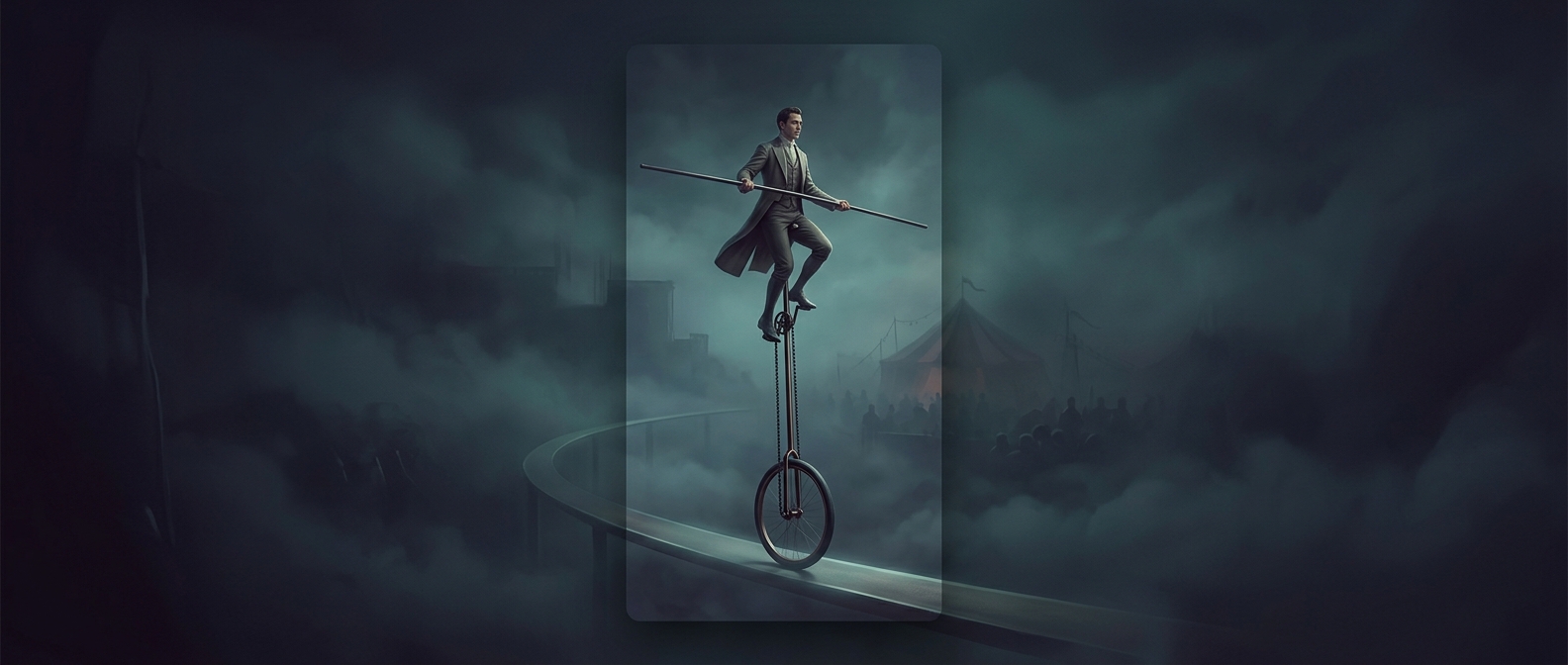
A chain breaks the wheel-size limit
On an ordinary unicycle, the pedals are fixed directly to the wheel’s axle. That makes the wheel do two jobs: it supports the rider and turns when the rider pedals. The seat can rise only so far above it without making the wheel itself larger.
A tall, or “giraffe,” unicycle separates those jobs. The rider pedals a crank set higher up on the frame, and a chain carries that rotation down to a sprocket on the wheel. The frame can therefore lift the seat several feet above a relatively small wheel. The chain is what lets the rider sit high without needing a giant wheel.
Why the height makes balance harder
A unicycle stays upright through continual small adjustments: the rider shifts their weight and pedals forward or backward to keep the wheel beneath them. Raising the seat raises the rider’s center of mass—the point where their body’s weight is effectively concentrated. When that mass begins to tip, it has farther to move before the rider can correct it, so the high perch can feel less forgiving.
The chain also adds moving parts and requires the pedals and wheel to stay connected through a longer frame. But its payoff is striking: instead of climbing onto a huge wheel, a rider mounts a compact wheel beneath a tall structure, then balances high above the ground while steering and pedaling through that narrow point of contact.