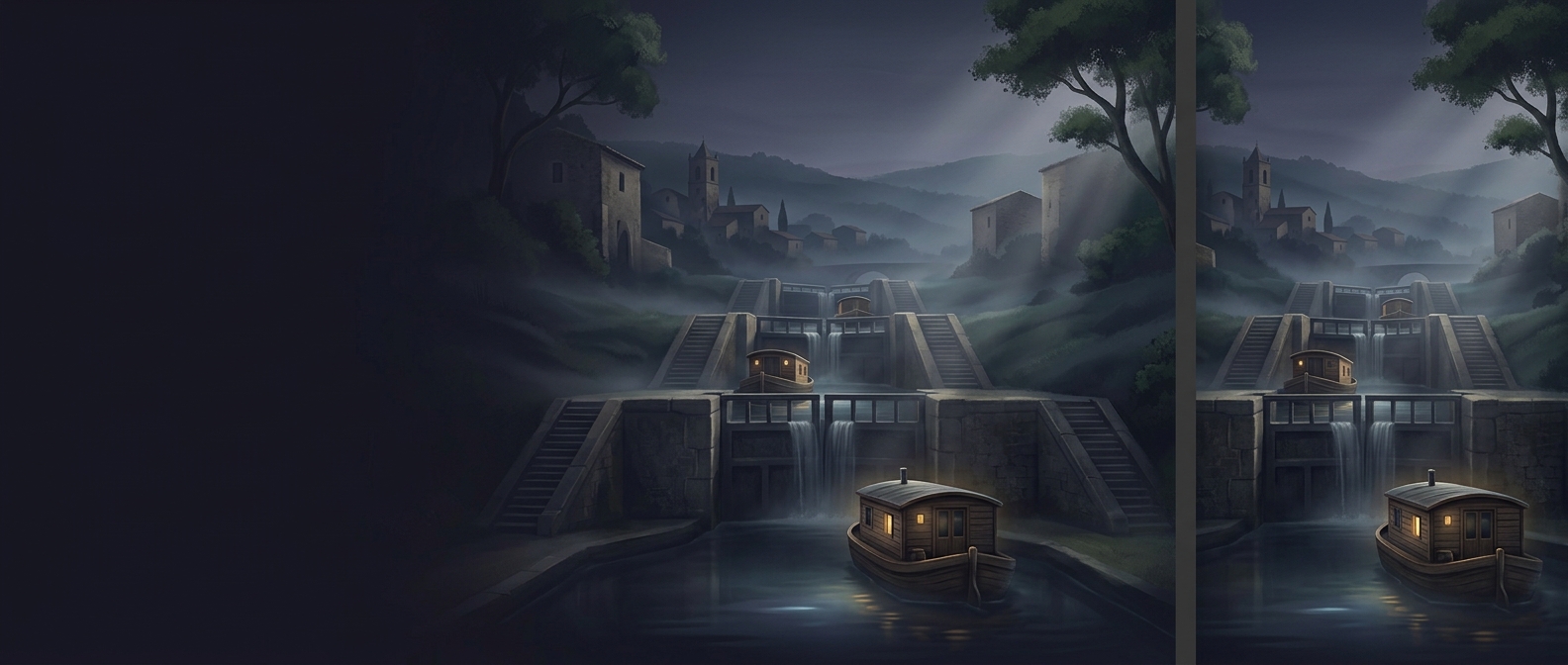
How a staircase of locks moves a boat uphill
At Fonseranes, the canal does not climb a slope continuously. It rises in stages. Each lock chamber is a water-filled basin between gates: a boat enters, the gates close behind it, and water is let in from the higher chamber ahead. As the water level rises, the boat rises with it. When the levels match, the next gate can open and the boat moves on.
The process is reversed for boats traveling downhill. Water drains from each chamber into the one below, lowering the boat until it can pass through the lower gate. The gates hold back the difference in water level; the small sluices built into them do the careful work of filling or emptying a chamber.
Why the locks are linked together
A single lock can handle only the height difference between its two ends. At Fonseranes, a chain of chambers divides the canal’s steep change in elevation into manageable steps. The linked arrangement lets boats climb or descend without needing a separate water-powered lift. It also means each passage is a sequence: gates and water levels have to be managed in order, with the boat held securely inside each chamber while the next level is prepared.
The staircase was built as part of the Canal du Midi, the seventeenth-century waterway designed to connect the Mediterranean region with the Atlantic-side canal network. Its engineering challenge was not simply to cut a channel across southern France, but to carry boats over changing terrain while keeping the route navigable.
For today’s boaters, that design turns a stretch of travel into a hands-on operation. They must guide the boat into each chamber and work through the transitions; the canal itself supplies the water that lifts or lowers it. At Fonseranes, the journey forward is made one water level at a time.