From Boat Ride to Film World—and Back Again
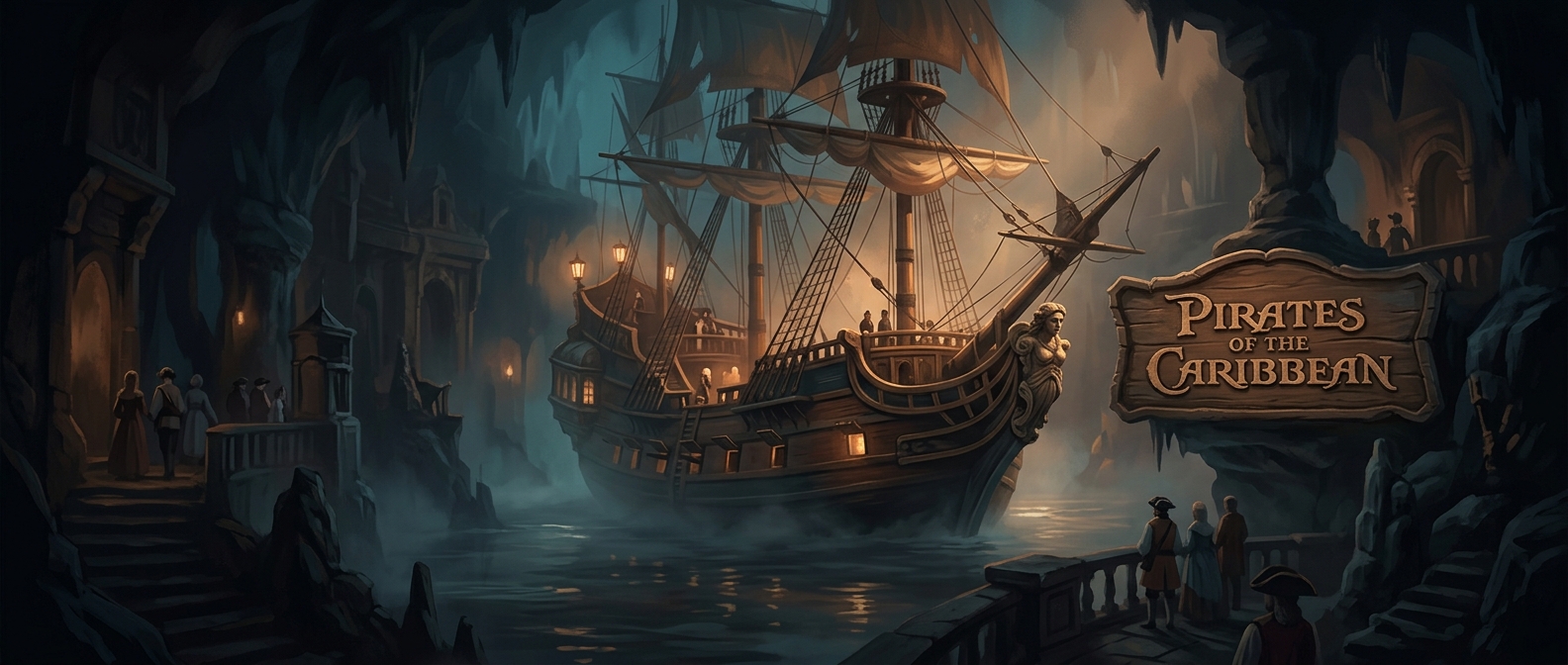
When Pirates of the Caribbean opened at Disneyland in 1967, it offered a sequence of scenes, not a movie-style plot. Riders drifted through a staged pirate world: a dark passage, a burning town, and rowdy pirates, all animated and accompanied by sound. The slow boat ride let designers control what visitors saw and when, turning atmosphere and visual spectacle into the main event.
That format gave filmmakers a setting to build on, but not a complete story to adapt. The films created characters and a continuing adventure around the ride’s pirate imagery, especially the unpredictable Jack Sparrow. In that sense, the movies did more than retell an existing narrative: they supplied one that the attraction had never needed.
A Rare Two-Way Adaptation
After the films became popular, Disney added Jack Sparrow to the ride. This reversed the familiar direction of adaptation. Instead of a ride being redesigned to match a movie from the start, an established attraction absorbed a character invented for its screen version.
The change also shows the tradeoff involved. A ride depends on a fixed sequence of sights that can be understood in a brief pass; a film can develop a character across a much longer story. Adding Sparrow lets visitors recognize the movie’s hero, while the attraction still works as a procession of pirate scenes rather than a retelling of a particular film. The franchise’s unusual loop—from ride to movies and back into the ride—means a character created for the screen now appears in the world that inspired it.