A spiritual prehistory, not a fossil record
In Helena Blavatsky’s Theosophy, humanity’s beginnings belonged to a hidden spiritual history rather than the biological history reconstructed from fossils. Her account described successive “root races”—vast stages of human existence unfolding across ancient continents. The earliest beings were not ordinary flesh-and-blood people: they were imagined as enormous, translucent, and only gradually becoming physical.
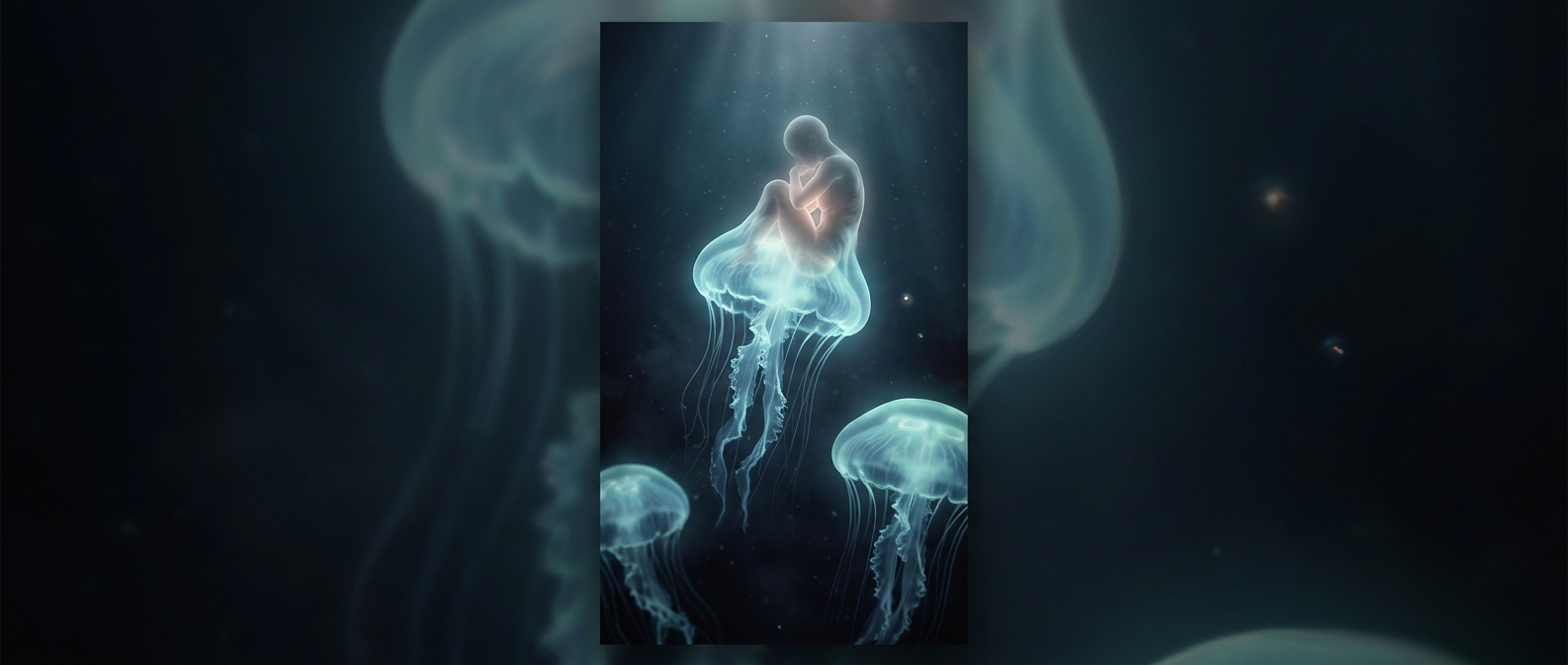
The jellyfish comparison captures one especially strange part of that story. Early humanity was said to float and reproduce by budding, splitting off new beings rather than producing children through sexual reproduction. These were claims within an esoteric cosmology, not observations about actual animals or ancestral humans.
Humanity’s descent into physical form
The sequence gave physical bodies a spiritual explanation. In this scheme, humanity began in a subtle, almost immaterial state and became denser over immense spans of time. Changes in bodily form and reproduction marked stages in that descent. Later accounts could therefore treat familiar human biology as a relatively recent phase, not the starting point.
That framework also made evolution mean something different from Darwinian evolution. Instead of describing populations changing through inherited variation and natural selection, Theosophy presented a cosmic progression in which spiritual development and material embodiment were intertwined. The image of a giant, budding “human” jellyfish is memorable because it turns that abstract idea into a bizarrely concrete scene: humanity, in this telling, had to become fully human.