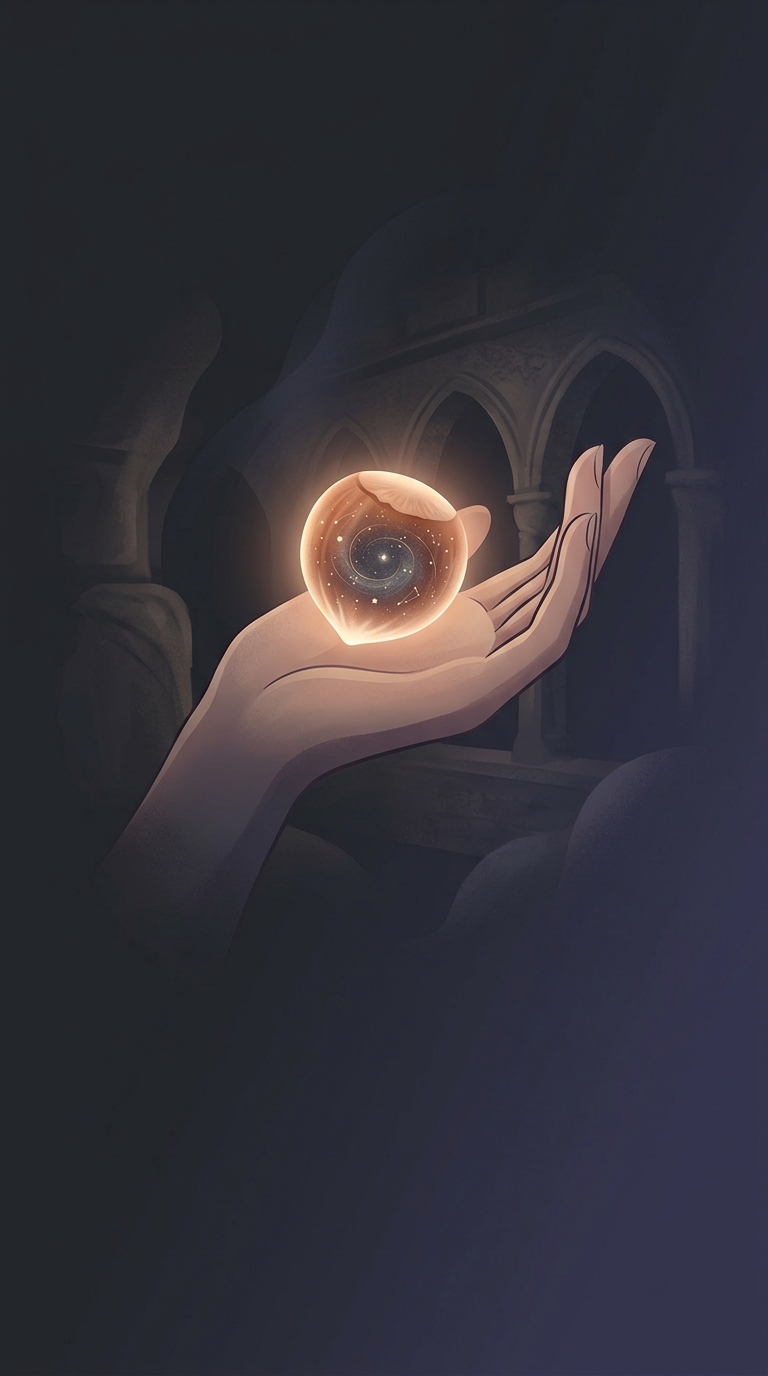
The hazelnut at the center of Julian’s vision
In the late 14th century, Julian of Norwich became gravely ill. As she later recounted, she experienced sixteen “showings”—visions she understood as revelations from God. One was strikingly small: she saw a hazelnut resting in the palm of her hand. It seemed so fragile that she wondered how it could endure. The answer she understood was that it continued to exist because God made it, loved it, and preserved it.
The nut was not a miniature universe in a literal or scientific sense. It was a compact image of dependence: everything that exists, however small or vulnerable, relies on divine care. Julian’s vision joined that idea to the Christian claim that creation is loved by its maker.
A life shaped by enclosure
Julian later lived as an anchoress, a religious woman who withdrew from ordinary society into a small cell attached to a church. Such a cell, called an anchorhold, was a place of prayer and contemplation, not simply a prison. It had openings that allowed essential contact with the outside world; the popular image of Julian in a completely windowless room is misleading.
From her anchorhold at St Julian’s Church in Norwich, she reflected on the visions and wrote them down. Her surviving work, Revelations of Divine Love, is the earliest surviving book in English known to have been written by a woman. It also preserves her effort to make sense of a difficult question: how divine love could coexist with suffering.
Why the small image mattered
Julian did not treat the hazelnut as an escape from that question. Its smallness made the point more vivid: what looks insignificant can still be held within a larger care. Centuries later, the image remains memorable because it turns a vast theological claim into something a reader can picture in one hand.