Why daylight does not brighten the lunar sky
On Earth, the sky looks blue because sunlight hits molecules in the atmosphere and scatters in many directions. That scattered light reaches your eyes even when you are not looking straight at the Sun, filling the sky with color and softening the contrast between bright and dark.
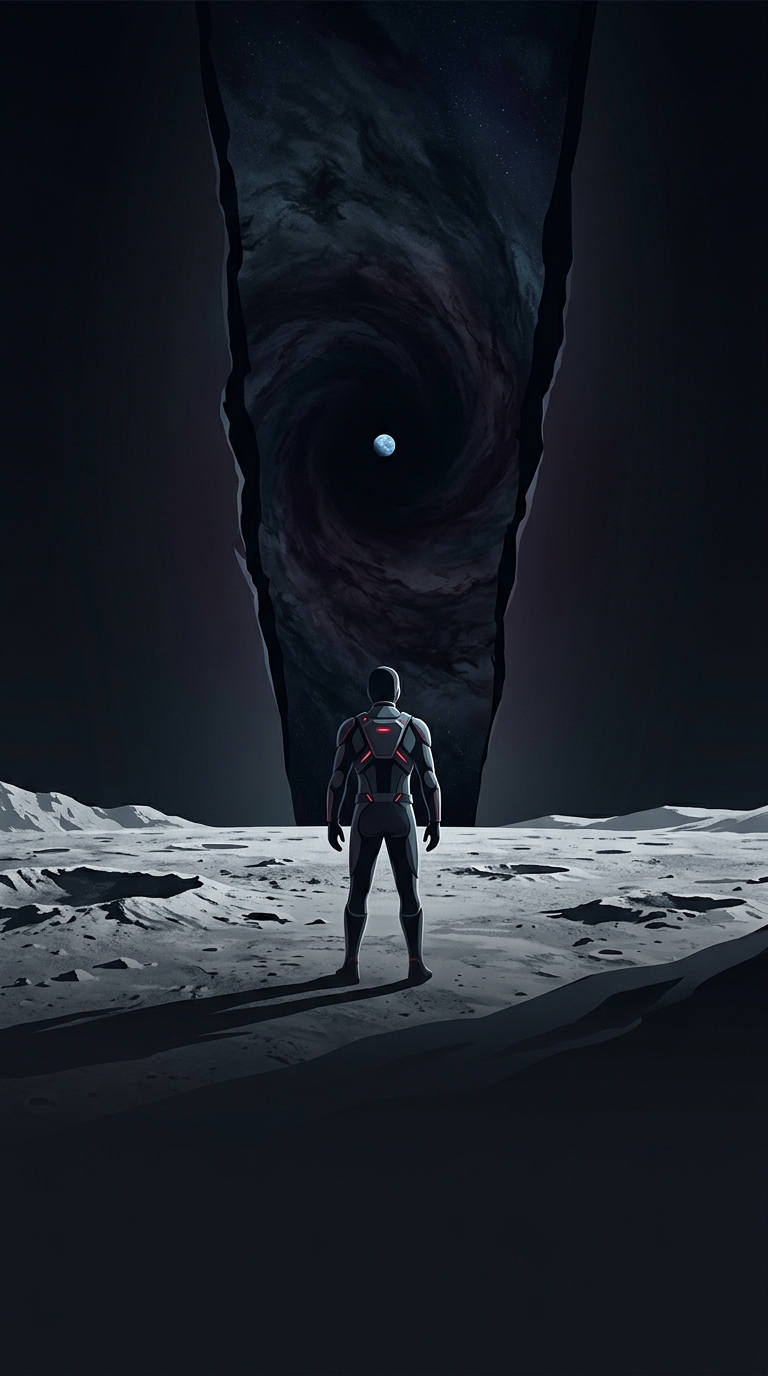
The Moon has no substantial atmosphere to do that job. Its extremely thin exosphere—just a sparse collection of particles—cannot spread sunlight around in a visible haze. So the space above the horizon stays black, even while the Sun shines intensely on the ground.
A bright landscape beneath a black backdrop
A lunar observer would see sunlight falling directly on the surface, with sharply defined shadows and a stark boundary between illuminated ground and shade. The blackness would not mean the Sun had set; it would mean there is no air to scatter its light across the view. The Sun itself would be dazzling, so looking toward it would be unsafe without appropriate protection.
Stars may be present in that black sky, but seeing them depends on conditions and the observer’s eyes. A brightly lit lunar surface can make faint stars hard to pick out, much as glare can hide dim details. The striking scene is therefore not a uniformly dark world: it is a sunlit landscape under a sky that remains black.