A Road Becomes a Nutcracker
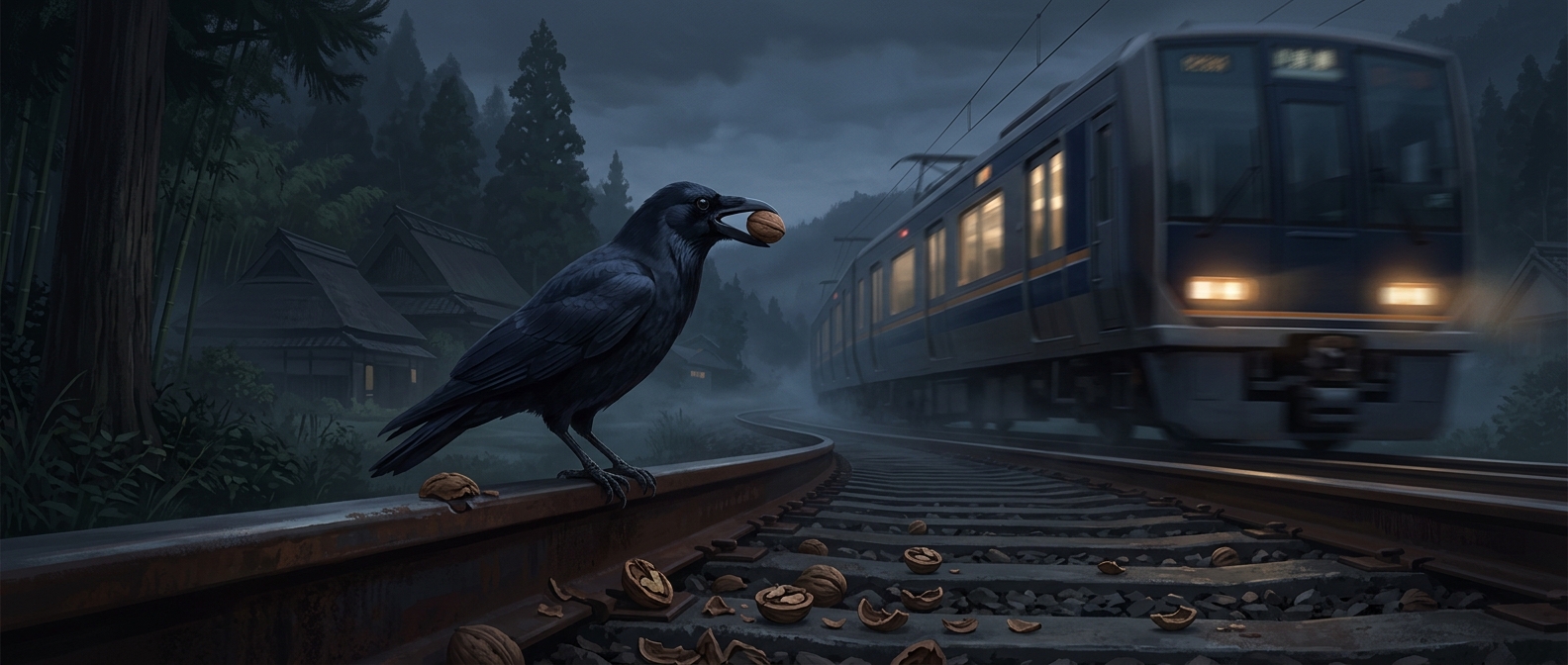
A walnut’s shell is tough enough to resist a crow’s beak, but a car can supply far more force. By placing a walnut in a vehicle’s path, a crow turns passing traffic into a tool: the tire breaks the shell, leaving the edible kernel accessible without the bird having to crack it itself.
The useful part is coordinating two different pieces of the setting. The crow has to leave the nut where a car can crush it, then approach when traffic is stopped. A signal or crosswalk can create that brief opening, reducing the chance that the bird will be struck while it retrieves the food.
Using the Rhythm of Traffic
This is not simply a matter of dropping a nut onto a road and hoping. The bird’s actions fit the sequence of a busy intersection: vehicles move, a walnut is crushed, and a pause in traffic makes the food safer to reach. The street’s signals—built for people and cars—also shape when a crow can forage there.
That does not mean every crow uses this tactic, or that each bird follows a perfectly planned routine. But the behavior shows how flexible foraging can be: instead of relying only on its own beak, a crow can make use of a powerful object in its environment and time its approach around the resulting danger. At a crosswalk, the red light is more than a traffic rule; for a hungry bird, it can be the moment a cracked walnut becomes reachable.