A medieval attempt to turn a legend into a machine
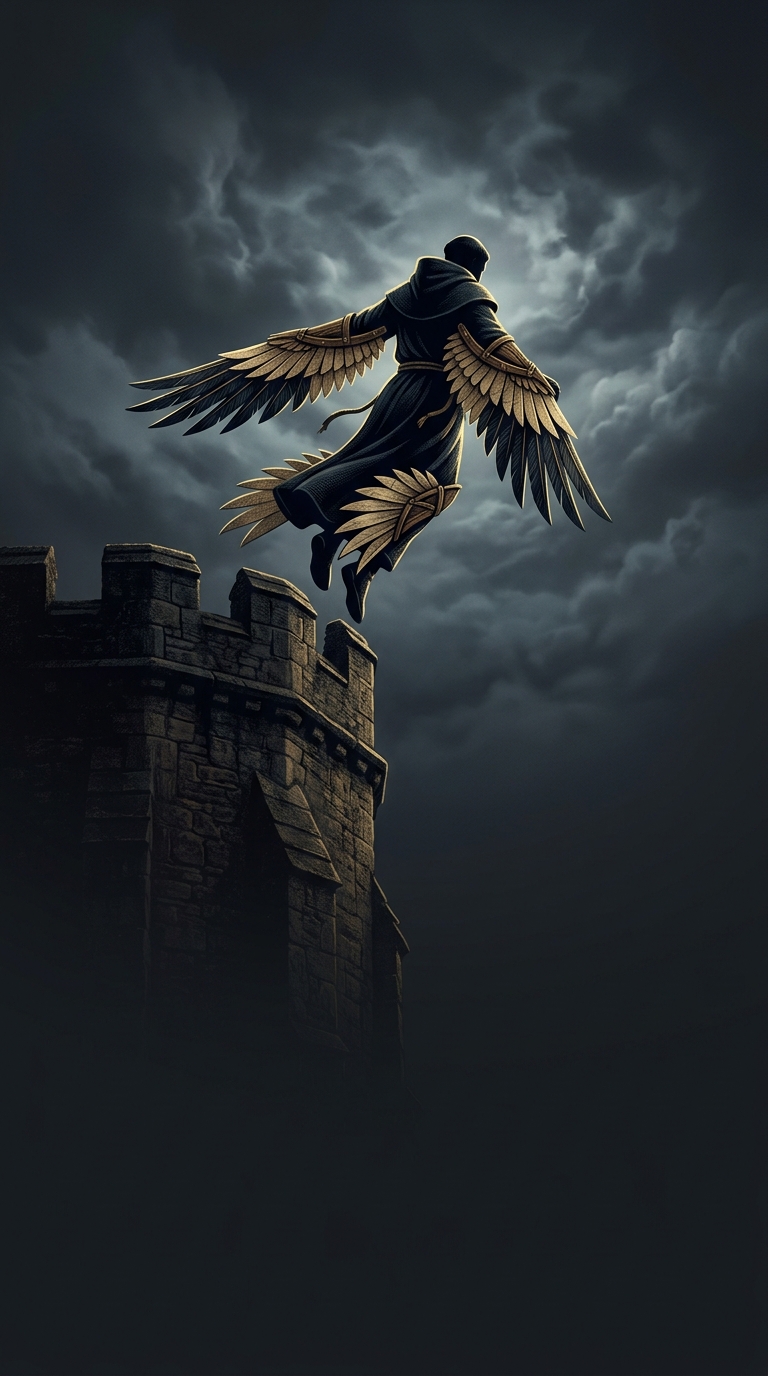
Eilmer’s flight survives in the account of William of Malmesbury, a historian writing in the twelfth century—roughly a century after Eilmer lived. William says the monk was inspired by the story of Daedalus, the legendary inventor who escaped using wings. Eilmer’s attempt was therefore more than a leap of faith: it was an effort to make a familiar tale work in the physical world.
The account does not describe a carefully engineered aircraft. It gives no dimensions, materials, or detailed explanation of how Eilmer built his wings. But attaching them to both hands and feet suggests he was trying to imitate a bird’s spread shape, using his body to hold the surfaces open.
Getting airborne was only one problem
A wing can slow a fall by pushing against the air, but a person also needs to keep the wing surfaces at a useful angle and control where the body points. A gust can disrupt that balance. Without a reliable way to steer or stabilize himself, Eilmer could not simply choose a safe landing spot once he was aloft.
William’s account says Eilmer later identified a missing feature: a tail. A tail could help steady an airborne body, much as the rear surfaces of an aircraft help control its pitch and direction. That explanation makes the story memorable, though it does not establish exactly how the wings were shaped or how the flight unfolded.
What the story can—and cannot—tell us
The episode is known through a medieval narrative, not a surviving design or eyewitness record. Its details should be read as William’s account of Eilmer, rather than as a modern flight test report. Even so, the story preserves a striking early attempt to confront the practical limits of human flight.
Eilmer’s reported crash points to the central challenge: leaving a tower was not the same as controlling a descent. In the tale, the missing piece was not courage but a way to stay stable in the air—and to arrive on the ground intact.