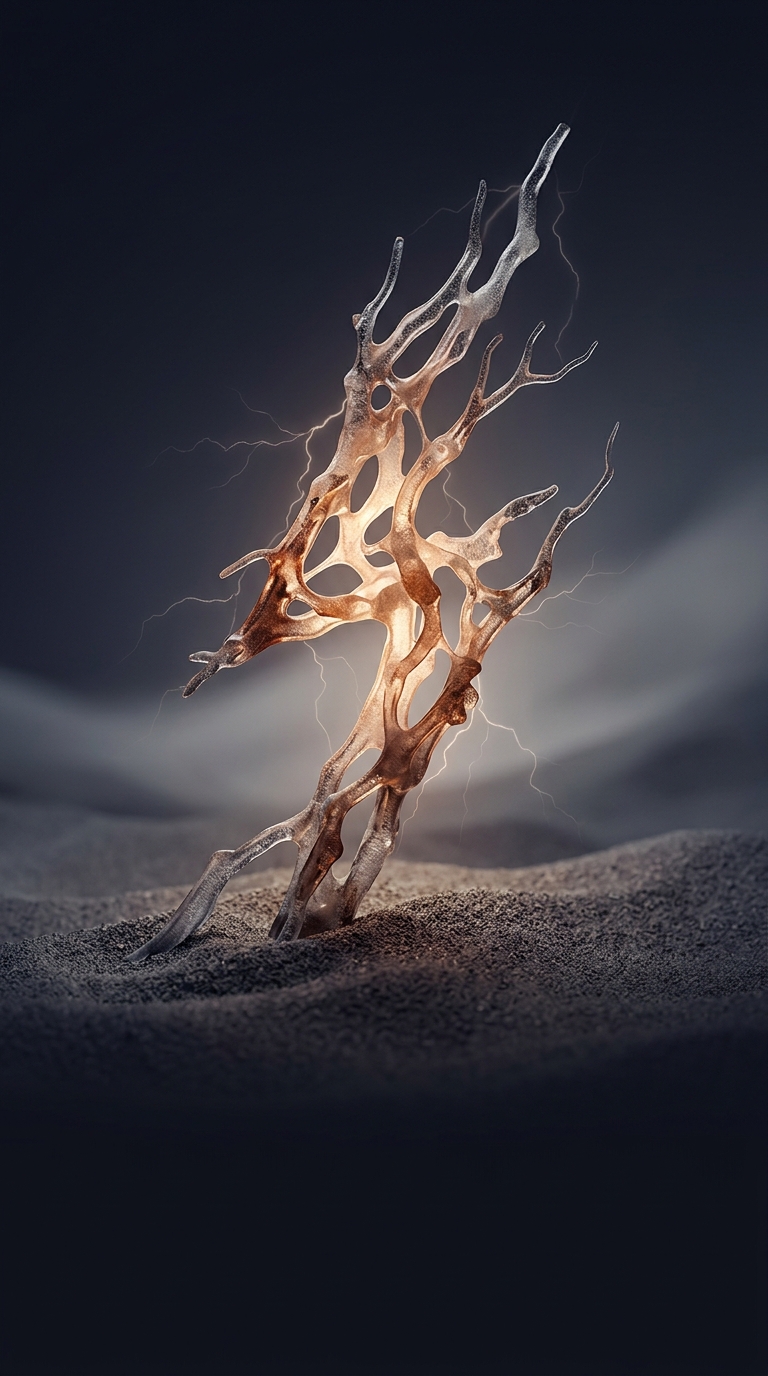
How a lightning bolt leaves glass underground
A lightning strike is not just a flash across the sky. Once it reaches the ground, electrical current can travel through sand in a narrow, branching path. The current heats the material around that path so intensely that some of its silica—the mineral found in quartz and much ordinary sand—melts and fuses into glass.
Moisture in the sand can help shape the result. As water heats rapidly, it becomes vapor and expands, pushing material away from the hottest channel. The glass forms around that route, often leaving a hollow center. Because the current spreads through uneven ground rather than following a perfectly straight line, the channel can fork below the surface.
A fragile map of the strike
The glass cools quickly after the electrical pulse ends, preserving an irregular tube called a fulgurite. Its branching shape can reveal how the current moved through the ground, but it is not a complete map of the bolt: a fulgurite records only the portion of the discharge that left a glassy trace, and many strikes leave no preserved tube at all.
Fulgurites are often delicate, with thin, rough walls that may break when the surrounding sand is disturbed. That fragility is part of their significance: a brief event can leave behind a physical trace, but uncovering it intact means recovering a structure that was formed underground and held in place by the very sand that can crumble away.