Why a railway is divided into blocks
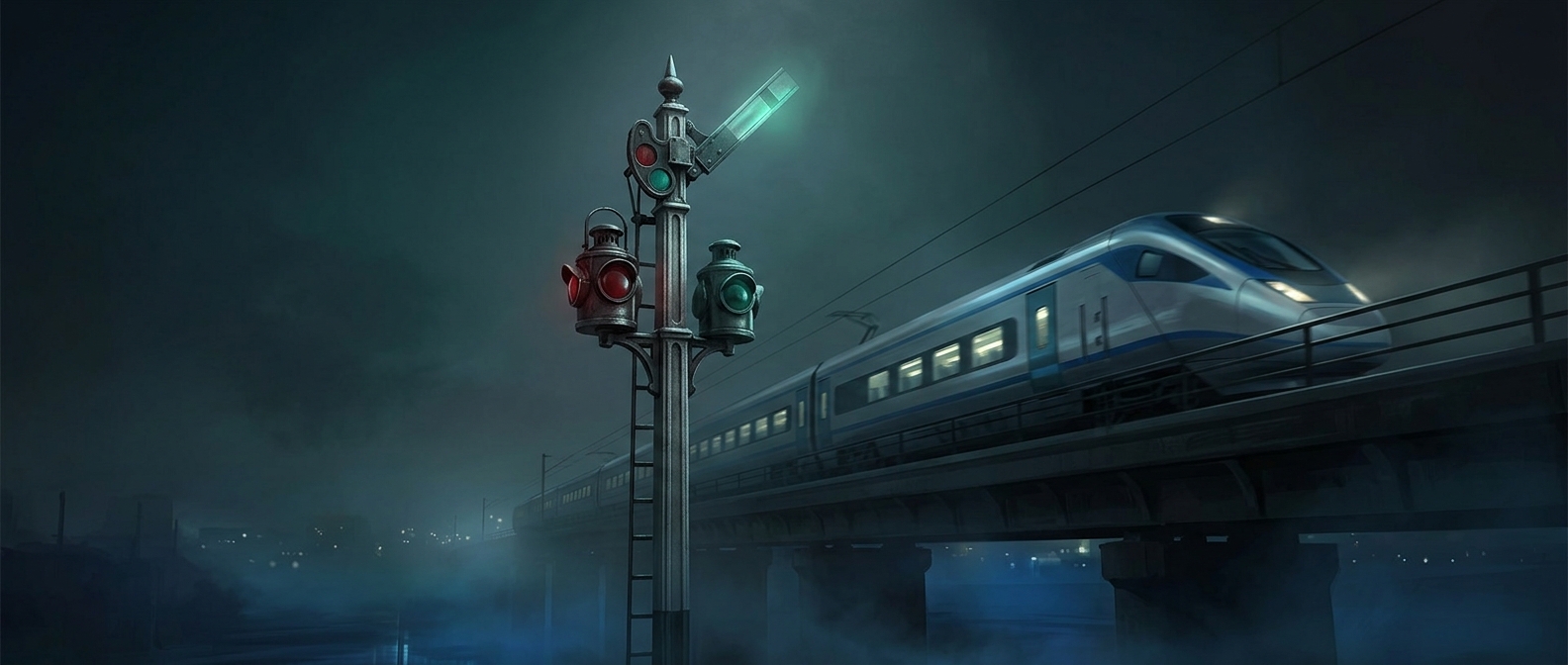
A train cannot stop as quickly as a car. At speed, it may need a long stretch of track to brake, so railways plan separation ahead of the train rather than waiting until two trains are close. In a fixed-block system, the route is split into sections called blocks, and the signaling system aims to keep a train from entering a block that is still occupied.
A signal’s instruction can depend on more than the block immediately ahead. If that block is clear but the one after it is occupied, the driver may be told to slow down or prepare to stop. This gives the train room to brake before reaching the obstruction. The exact pattern of signals and permitted speeds varies by railway.
How the railway knows a block is occupied
One common method is a track circuit: electrical current runs through the rails, and a train’s metal wheels and axles help complete the circuit. When a train enters the section, the electrical change tells the signaling equipment that the block is occupied. Another method, an axle counter, records axles passing into and out of a section; if the counts do not balance, the system cannot treat the block as clear.
The signals and track equipment also work together through interlocking—arrangements that prevent incompatible routes from being authorized at the same time. Safety-minded design generally makes uncertainty restrictive: if equipment cannot confirm that a section is clear, it should not give a train permission to enter it.
An old rule, updated in layers
The block principle took shape as railways expanded in the 19th century, when trains needed a practical way to share a line without relying on drivers to judge distances by eye. Electronics have since made detection and control more capable, but they have not erased the underlying problem: a fast, heavy train needs space to stop.
Some modern systems can manage separation differently, including by tracking trains more continuously rather than relying only on fixed sections. But wherever fixed blocks remain, a new train may still be following a rule devised for an older railway: don’t enter track the system cannot confirm is clear.