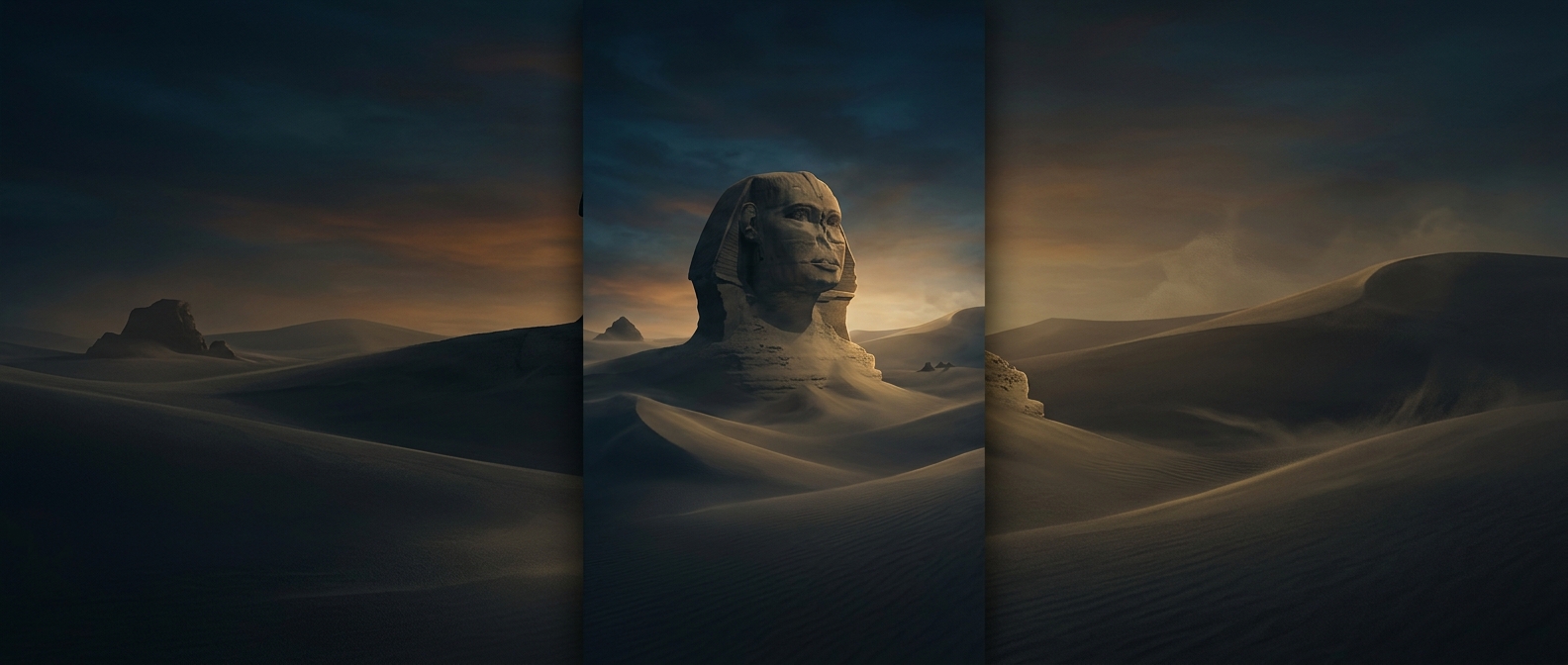
Why the Sphinx’s head stayed visible
The Great Sphinx stands on the Giza Plateau, where wind can sweep loose desert sand into low areas between the rocky outcrops. Its body lies close to the ground, while its head rises higher. Sand therefore piled around the body first, leaving the head exposed like a landmark above a dune.
This was not a single burial that lasted unchanged for centuries. Sand accumulated again and again, and people cleared it away at different times. A large stone monument could be partly hidden, uncovered, and then buried once more as the desert shifted.
The Sphinx was cleared before modern times
Evidence of an early clearing survives in the Dream Stele, a stone slab set between the Sphinx’s paws by the pharaoh Thutmose IV. Its inscription tells of the prince clearing sand from the monument before becoming king. The stele makes the Sphinx’s burial more than a modern archaeological discovery: people in ancient Egypt also encountered it partly swallowed by sand.
In the modern era, archaeologist Émile Baraize led a major excavation from 1925 to 1936, removing sand and debris from around the monument. That work revealed the Sphinx’s full form, but it did not end the challenge of keeping the statue exposed. The same landscape that had hidden its body continued to shape the practical work of preserving it: the Sphinx had to be uncovered, and then protected from the forces that had covered it.