The Ant Farm and the Letter Dice
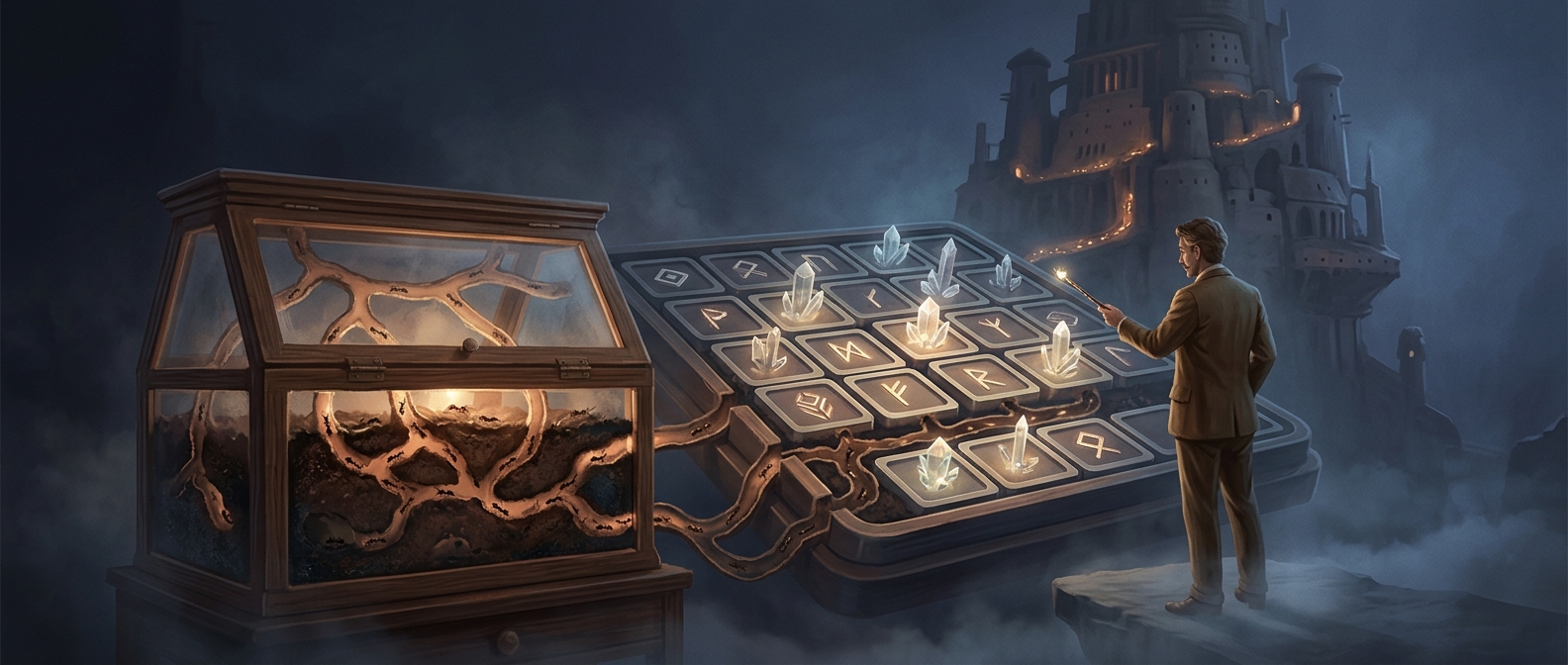
Milton Levine’s ant farm and Boggle share a simple design idea: make a small, active world that invites people to keep watching—or playing. Levine helped popularize the ant farm, a clear-sided habitat where children could observe ants tunneling through sand. Boggle applies a similar pull to language: shake a tray of letter dice, then hunt for words in the jumble.
The ant farm turns an animal’s hidden work into a visible pattern. Boggle turns a familiar skill—spotting words—into a quick search with a changing layout. In both, the user supplies the attention: the ants make the tunnels; the player finds the words.
A Similar Instinct, Different Inventors
The two products are easy to connect, but the attribution needs a correction: Milton Levine did not invent Boggle. Boggle is credited to game designer Allan Turoff. Levine is associated with the toy business and the ant farm, not with Boggle’s design.
That distinction makes the comparison more interesting than a simple inventor anecdote. A toy can be compelling because it gives a child a process to watch, or because it offers a small challenge that resets each time. Levine’s ant farm and Turoff’s letter game use different materials and mechanics, but both make curiosity repeatable: there is always another tunnel to inspect, or another arrangement of dice to search.