Why a Brief Kiss Became a Public Controversy
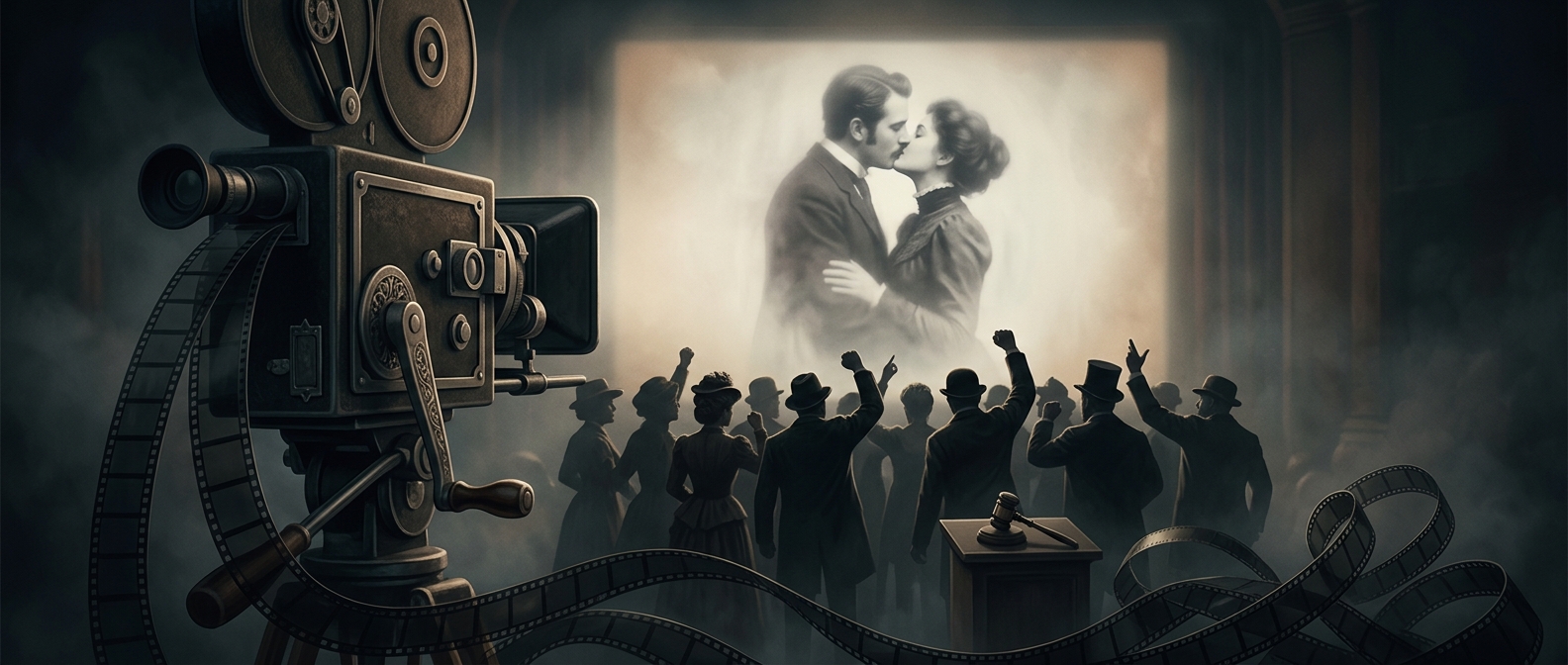
In 1896, audiences were still learning what moving pictures could show. Thomas Edison’s studio filmed stage performers May Irwin and John Rice reenacting a moment from the popular comedy The Widow Jones. The camera held close enough to make their faces and puckered lips the whole event: a small, ordinary gesture became an unusually direct spectacle.
That intimacy helped make the clip notorious. Onstage, a kiss was part of a larger scene, seen from a distance and surrounded by dialogue and action. On film, viewers could watch the gesture enlarged and repeated in a way that felt startlingly private. The actors’ exaggerated performance—part of the comic effect—also made the kiss more conspicuous.
A New Medium Made the Gesture Feel Different
The film was made for the kinetoscope, a cabinet viewers looked into one at a time. That private, close-up viewing experience differed from watching a play in a theater, where the audience shared a room and saw performers at a remove. The camera did not merely record the stage moment; it changed how closely people could inspect it.
Newspaper editorials treated the scene as a public moral concern and called for police intervention. Their reaction reveals a tension that followed early cinema: the technology offered an intimate view to individual spectators, while the images circulated as a commercial attraction. The controversy was not just about what the actors did. It was also about who controlled what audiences could see—and whether a new kind of entertainment needed policing.
The clip’s notoriety helped establish that film could provoke arguments as well as amusement. A kiss that might have passed within a stage comedy became a debate about the boundaries of public entertainment.