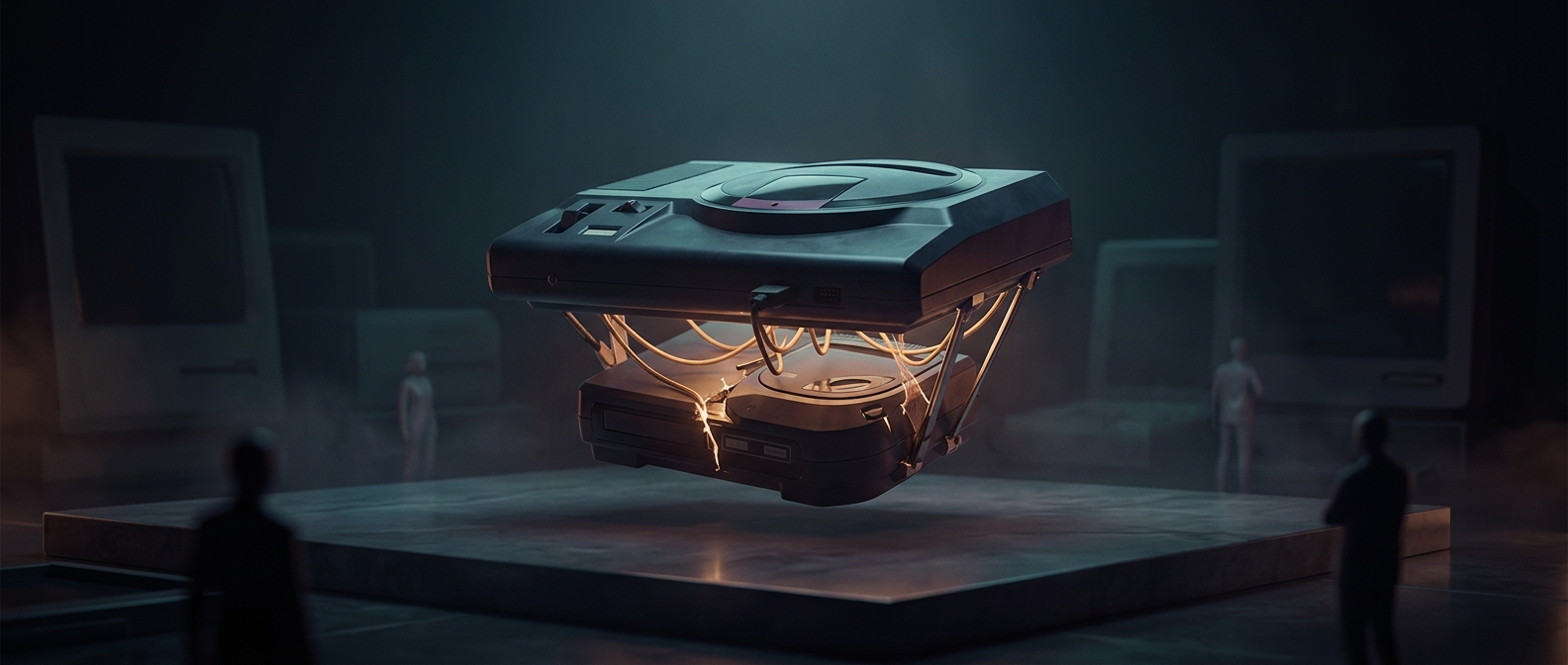
The Sega CD Was an Add-On in More Than Name
The Sega CD brought a CD-ROM drive and additional game hardware to the Genesis, but it did not replace the original console. The Genesis remained the system’s main unit, while the add-on connected beneath it. That arrangement let owners expand a console they already had—but it also meant the new capability arrived as another piece of equipment rather than as a slimmer, single machine.
The CD unit needed its own substantial power supply. So the setup involved not just a second box, but another bulky component and its power connection. Stacked together, the units occupied more vertical space than the Genesis alone, and their combined footprint could be an awkward fit on a typical entertainment-center shelf.
The Tradeoff of Expanding an Existing Console
An add-on can preserve the investment in a main console, but it must fit around that console’s existing shape and connections. The Sega CD’s under-console placement made the two units read as one tall stack, while its separate power supply made the expansion harder to ignore in everyday use.
That was the physical cost of upgrading by attachment: the Genesis gained CD-based capabilities without being replaced, but the living-room setup grew into a small tower that might not fit where the original console had.