A hunting team with competing interests
When an octopus hunts alongside fish, the partnership can make prey easier to catch. Fish search across open ground and may flush animals from hiding places; an octopus can reach into cracks and crevices where those animals retreat. Each hunter can therefore benefit from the other’s movements—but they are still competing for the same meal.
That tension is especially clear when several fish gather around an octopus. A fish may crowd the spot where the octopus is probing, or seize prey the octopus has uncovered. The group’s cooperation is practical, not necessarily harmonious: each animal has its own chance to eat.
What a punch can change
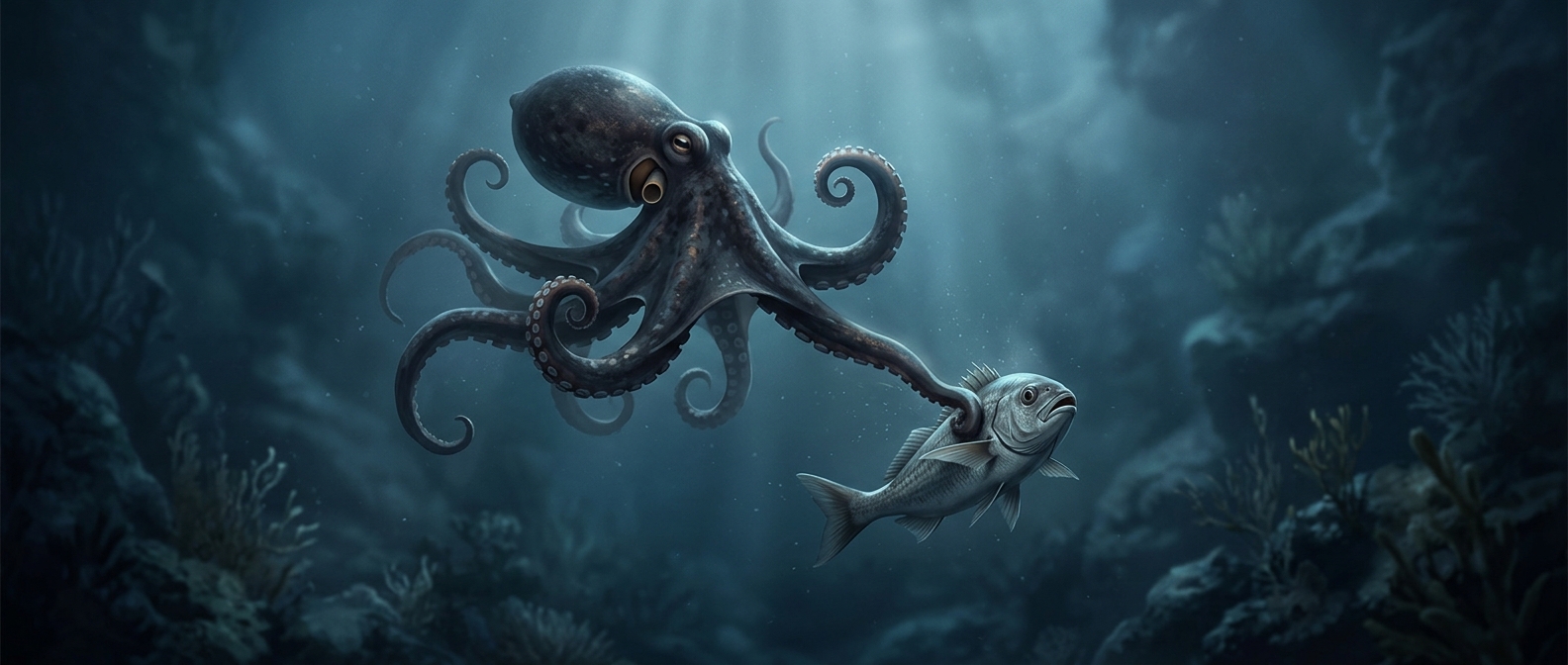
An octopus can thrust an arm into a nearby fish, abruptly knocking it away from the immediate hunting area. The movement may reduce competition at a particular patch of prey. It could also influence where a fish moves next, changing how the group searches—but a strike alone cannot show whether the octopus is deliberately directing the hunt or simply clearing space.
That distinction matters because the same visible action can have more than one effect. A punch can be both a shove that benefits the octopus and a cue that alters a partner’s behavior, without proving that the octopus planned it as a message.
Cooperation, with boundaries
The episode reveals a useful feature of mixed-species hunting: cooperation can persist even when partners sometimes interfere with one another. The octopus does not have to abandon the fish to protect its meal; a quick blow can reset the spacing and let the hunt continue. In this kind of partnership, teamwork is not the absence of conflict—it is a relationship that survives it.