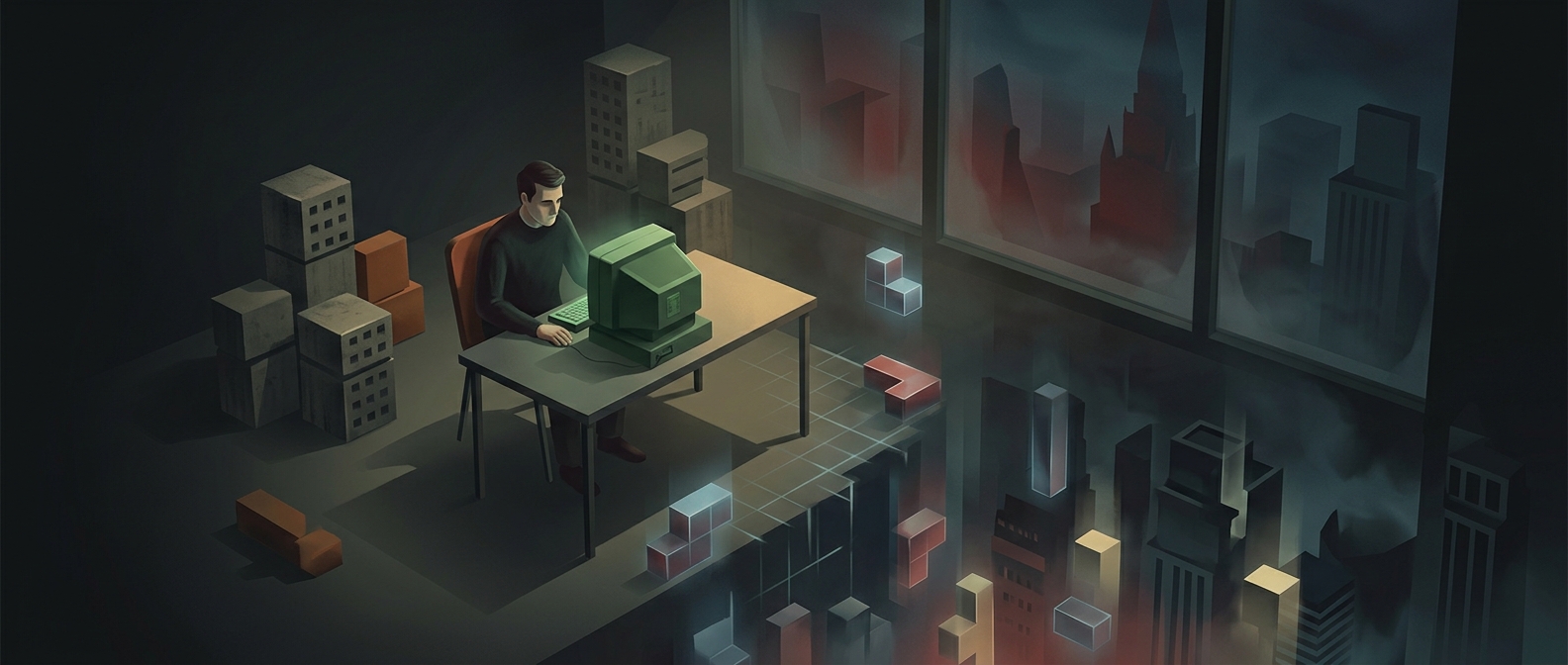
A puzzle built from text characters
The first Tetris did not have colorful blocks or smooth animations. Alexey Pajitnov wrote it in 1984 for the Electronika 60, a Soviet computer whose display setup could show text but not the kind of graphics later versions would use. So the falling pieces were drawn with clusters of text characters. The screen’s limitations became part of the game’s earliest design: the shapes had to be legible and the rules simple enough to follow on a plain terminal.
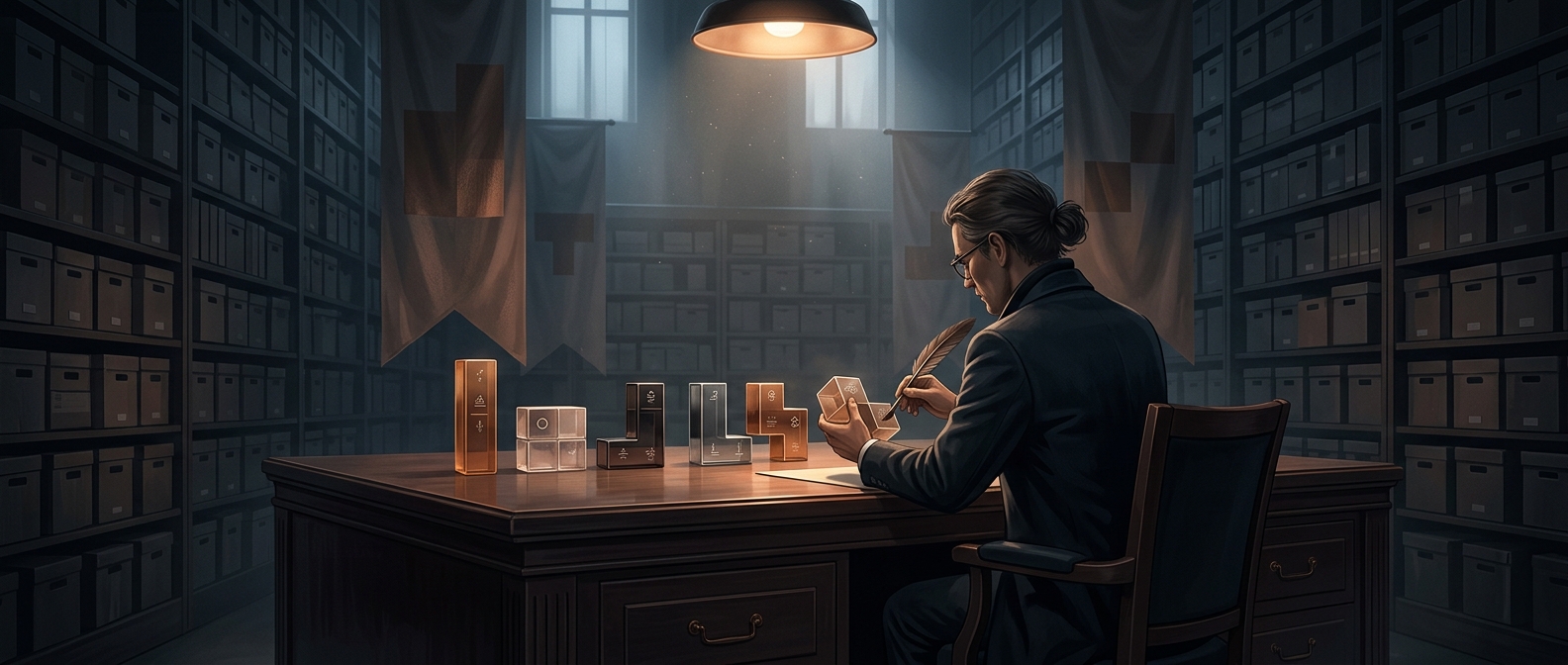
Pajitnov’s starting point was a puzzle with pieces made of five joined squares, called pentominoes. He reduced them to four-square pieces—tetrominoes—giving the game its name from the Greek prefix tetra, meaning four, combined with “tennis,” a sport he enjoyed. There are seven possible tetromino shapes, enough to create variety without making the game hard to read.
Why the rules fit the machine
Each piece falls into a narrow well, where the player can shift it sideways or rotate it to fit against pieces already stacked below. Fill an entire horizontal row and it disappears, opening space for what comes next. That clearing rule turns a simple stacking puzzle into a balancing act: a player must make room now without building a pile that blocks future pieces.
The game’s central loop needed no elaborate graphics or story. Its movement, rotation, and disappearing rows could all be communicated through the computer’s basic display. As the pile rises, decisions become more urgent, and a small mistake can leave a gap that is difficult to fill. The result was a game whose essential tension survived the jump from text characters to later screens: the player is always choosing between making a good move now and keeping the board playable later.