The letter names describe each piece’s outline
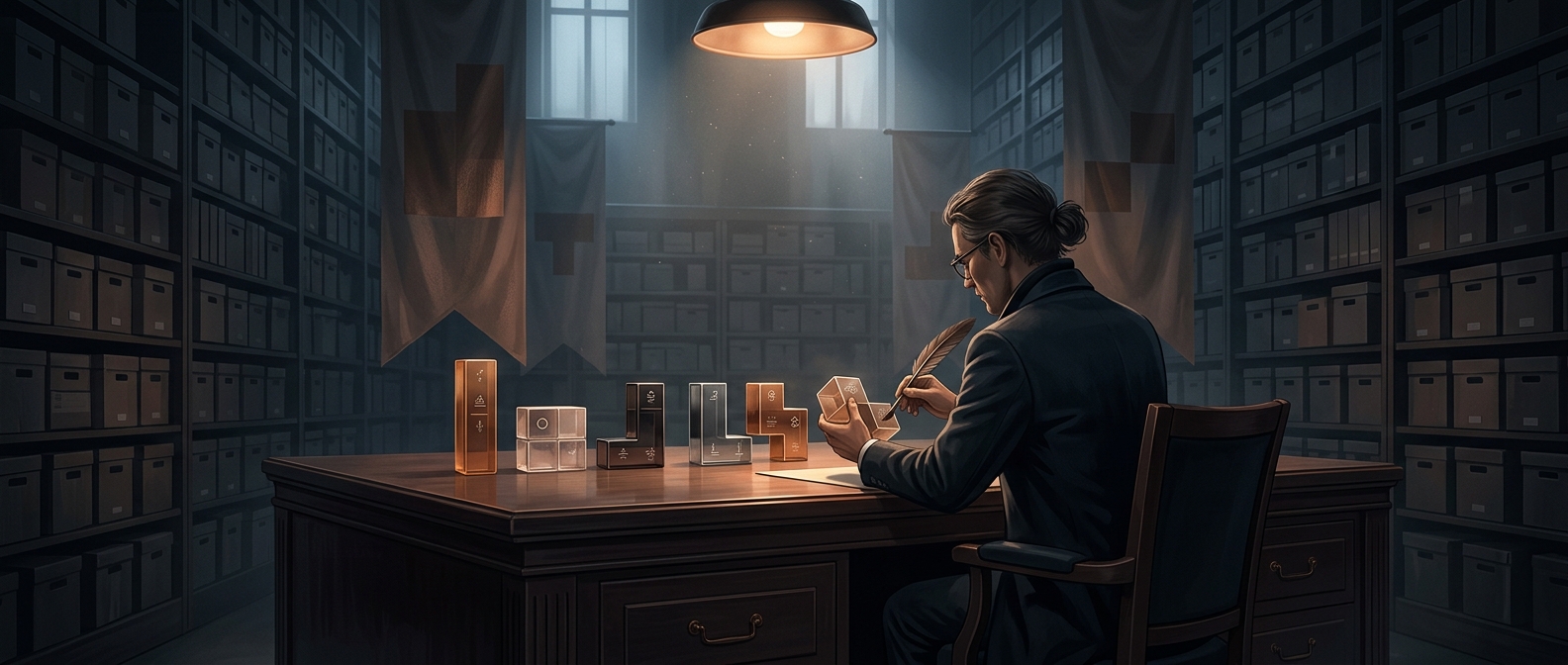
Every standard Tetris piece is made of four equal squares joined edge to edge. The game calls these pieces Tetriminos; their short names— I, O, T, S, Z, J, and L—identify the shape each one makes. An I-Tetrimino forms a straight line, while a T-Tetrimino has a stem beneath a three-square bar.
The names remain tied to the piece even as it turns. Rotate a T-Tetrimino, and it is still the T piece: its orientation changes, not its identity. That makes the letters a compact way to discuss pieces without describing their position on the screen.
A small vocabulary for a game of fitting shapes
The labels help players and designers talk precisely about what is falling. A player can recognize an incoming T piece and decide whether there is a place for it; instructions or discussions can refer to an I or an L without spelling out its geometry. The names also make clear that these are seven distinct shapes, not arbitrary arrangements generated anew each turn.
That precision matters because Tetris is built around planning several moves ahead. Knowing which Tetrimino is coming lets a player think about the gap it can fill—or the awkward space it might leave behind—before it reaches the stack.