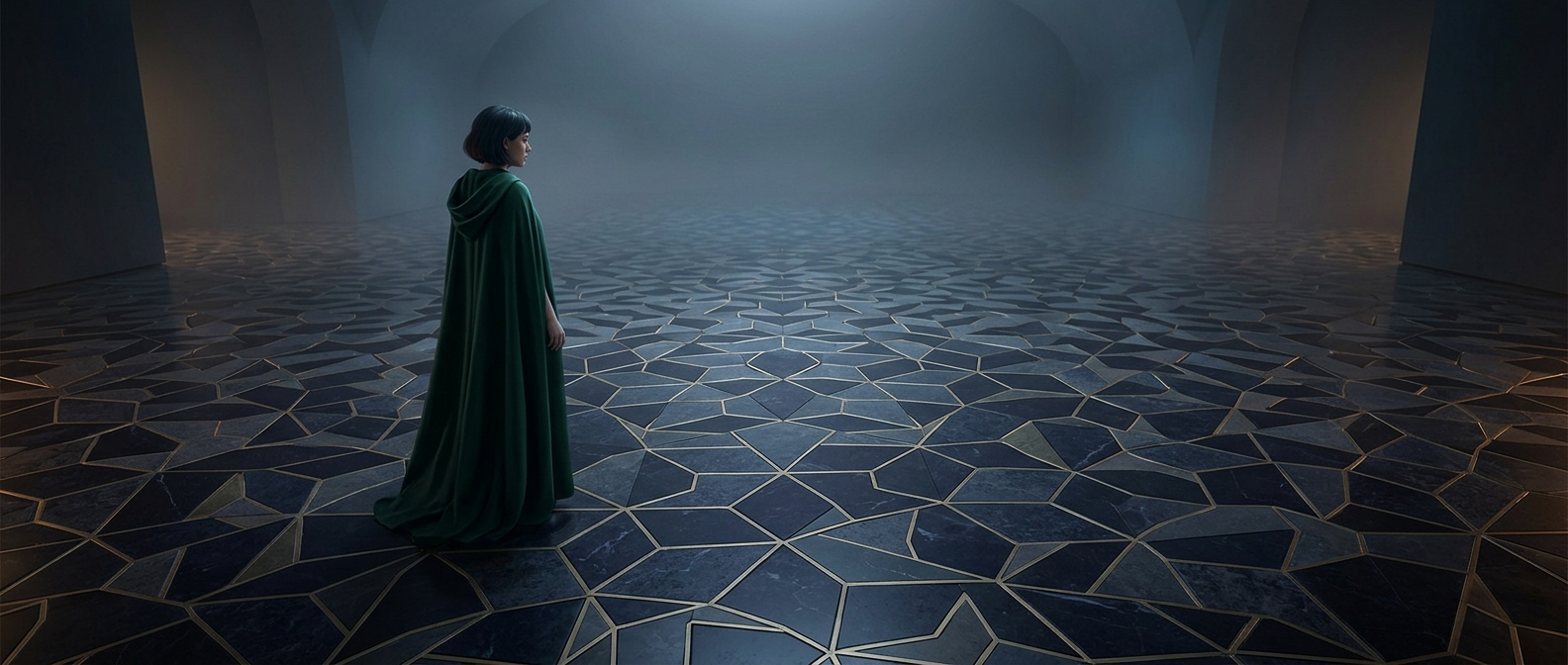
How two diamonds can prevent repetition
These patterns are a kind of aperiodic tiling: a small set of shapes can cover a surface, but the rules for joining them prevent the whole arrangement from repeating by translation. In a common example, the two tiles are rhombi—diamond shapes with equal-length sides but different angles. Their outlines alone leave many possible placements; small markings or other matching features on the edges restrict which neighbors can fit.
The key is that the rule acts locally. At each edge, a tile must meet a compatible edge, and those choices constrain the tiles around it. A placement that looks plausible in one spot may force particular arrangements farther away. Following the rules consistently produces a floor that can extend indefinitely without ever forming a repeatable wallpaper unit.
Familiar patches, no repeating unit
Nonrepeating does not mean chaotic. The constraints can make recognizable groups of tiles recur at different locations and scales. But finding the same small patch twice does not imply that the entire surrounding pattern matches. There is no single sideways shift that carries every tile onto an identical arrangement.
Some arrangements also have fivefold rotational symmetry: turn the pattern by one-fifth of a full circle around a suitable point, and it lines up with itself. That symmetry is striking because ordinary repeating wallpaper patterns cannot have fivefold rotational symmetry. The matching rules solve the apparent conflict by allowing local order and rotational symmetry without a repeating grid. A small collection of diamonds can therefore produce a surface that feels structured at every glance, yet has no smallest repeating tile.