How a Wheelchair Becomes a Dance Partner
A manual wheelchair turns because its two large drive wheels can move at different speeds. Push one rim harder than the other and the chair curves; drive one wheel forward while reversing the other and it can pivot in place. Small front casters swivel to follow the turn. In dance, those controls become a vocabulary: a gradual push can build a sweeping arc, while a quick change in direction can create a crisp spin.
The timing matters as much as the steering. Once the chair is moving, its momentum carries it through part of a turn, so a dancer has to anticipate the next move rather than simply react to it. A controlled stop, a change of pace, or a partner’s cue can redirect that motion. The chair’s frame and wheels are therefore part of the choreography—not just equipment that gets a dancer from one spot to another.
Choreography Built Around Shared Motion
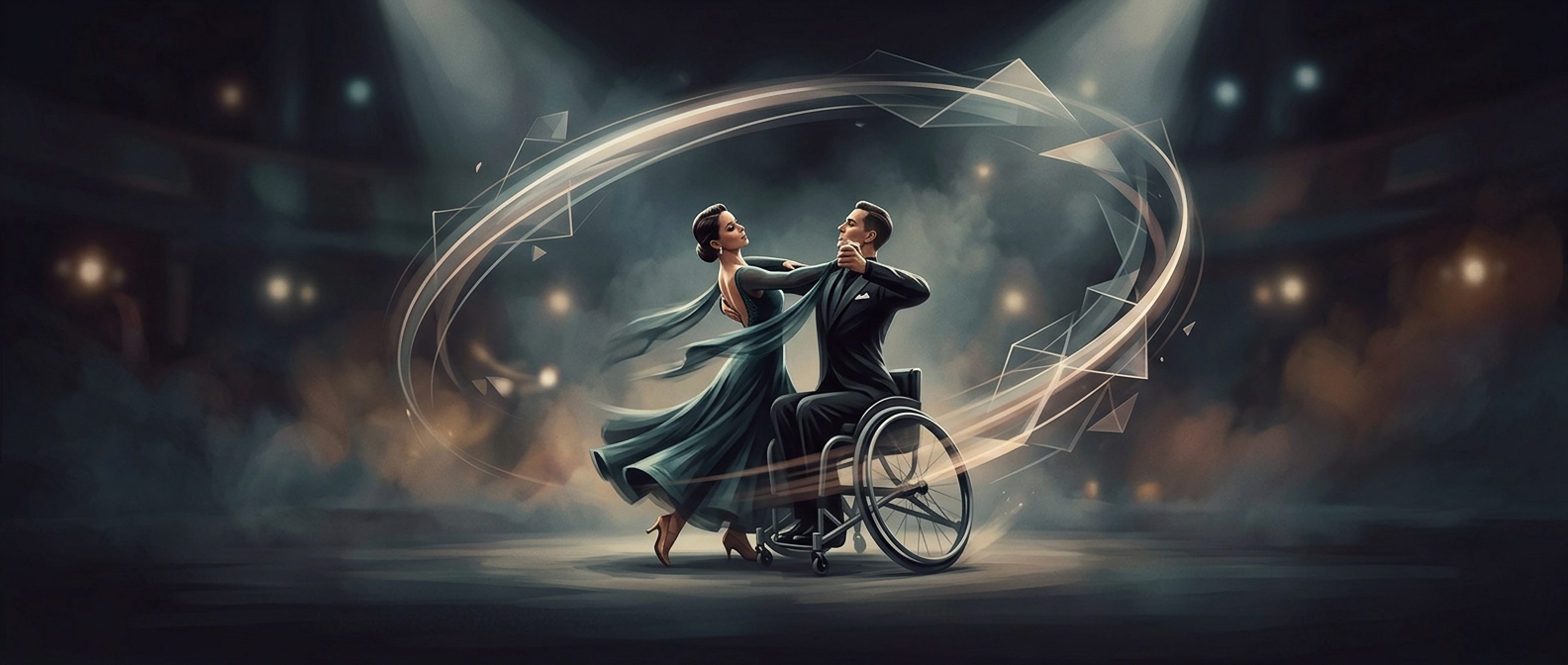
In partnered ballroom dancing, the chair user and standing partner coordinate their paths, spacing, and timing. A step designed for two people walking cannot simply be copied: the chair needs room to turn, and the partners must decide how to travel together without disrupting each other’s movement. Their connection may guide a change in direction or tempo, while each dancer still contributes independent movement.
That changes what the audience reads as a turn or a traveling step. The chair can sweep across the floor on a broad curve, then pivot sharply into a new line. The result is not a wheelchair added to a familiar dance; it is a dance shaped around the way its wheels accelerate, turn, and carry motion forward.