Turning Jupiter’s changing speed into distance
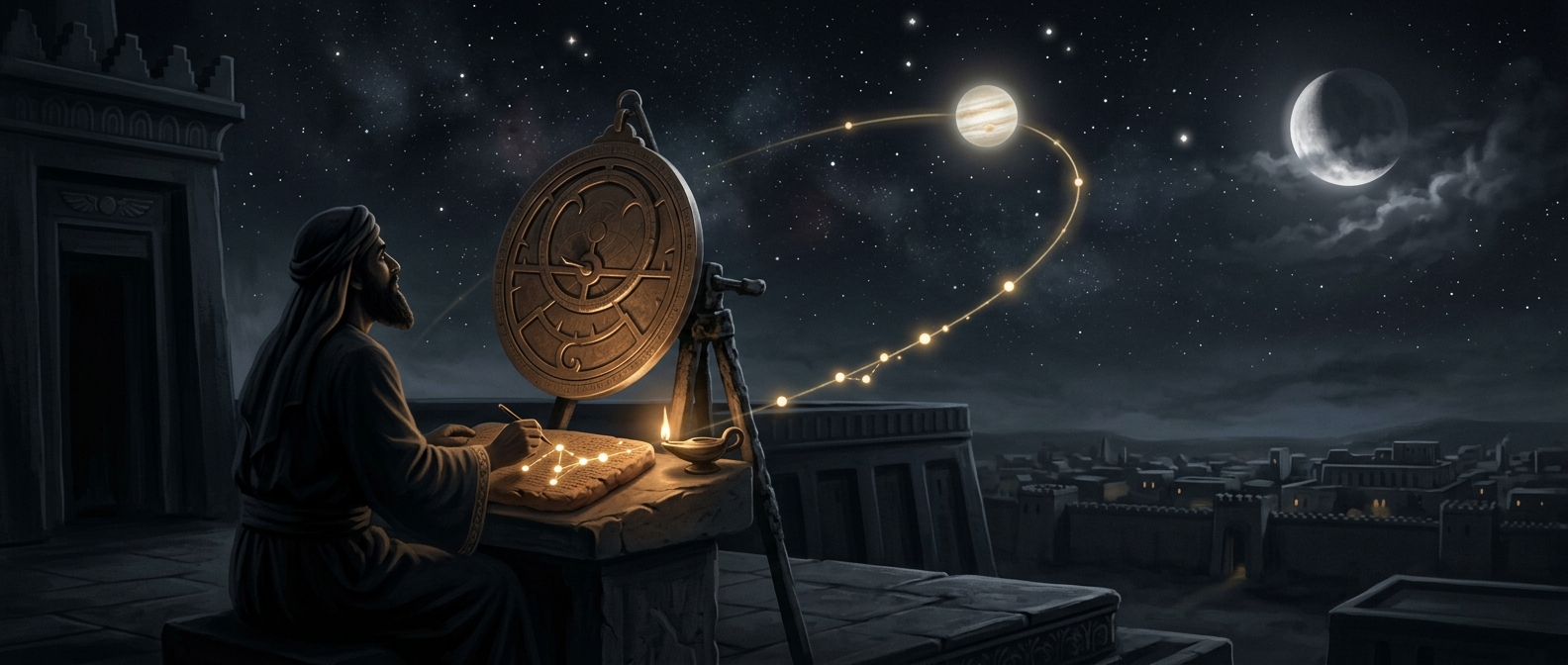
Jupiter does not cross the night sky at a steady rate. Its apparent motion—the change in its position against the background stars—varies over time. Babylonian astronomers needed a way to estimate where the planet would be, not just where it had been observed.
They treated its motion as a changing quantity that could be divided into intervals. For each interval, they worked with a starting speed and an ending speed. The distance covered could then be estimated from the average of those speeds multiplied by the time elapsed. In geometric terms, that calculation is the area of a trapezoid: a four-sided shape whose parallel sides represent the two speeds.
A geometric idea on a clay tablet
The trapezoid was not a map of Jupiter’s route through space. It was a practical model for adding up motion. Imagine Jupiter moving faster at the beginning of an interval and more slowly at the end: the average speed gives a better estimate of its progress than assuming either speed lasted the whole time.
Babylonian astronomers recorded numerical procedures and results on clay tablets. Their method shows how observation and calculation could work together: repeated observations supplied patterns in the planet’s changing motion, while arithmetic and geometry turned those patterns into predictions. The tablets preserve compact instructions for a calculation, rather than a modern chart or a picture of the sky.
Why the method mattered
A planet’s position mattered because its motion could be followed and anticipated over time. By converting changing speed into accumulated distance, astronomers could estimate where Jupiter would appear next. The striking step was treating motion as something that could be represented geometrically—not merely watched in the sky, but calculated through the area of a shape.