Turning Jupiter’s drift into a record
Jupiter does not hold still against the background of stars. From Earth, it usually shifts gradually from night to night, but its apparent motion can slow, pause, and seem to reverse direction as Earth passes it in orbit. A single look reveals little of that pattern. A sequence of observations can reveal much more.
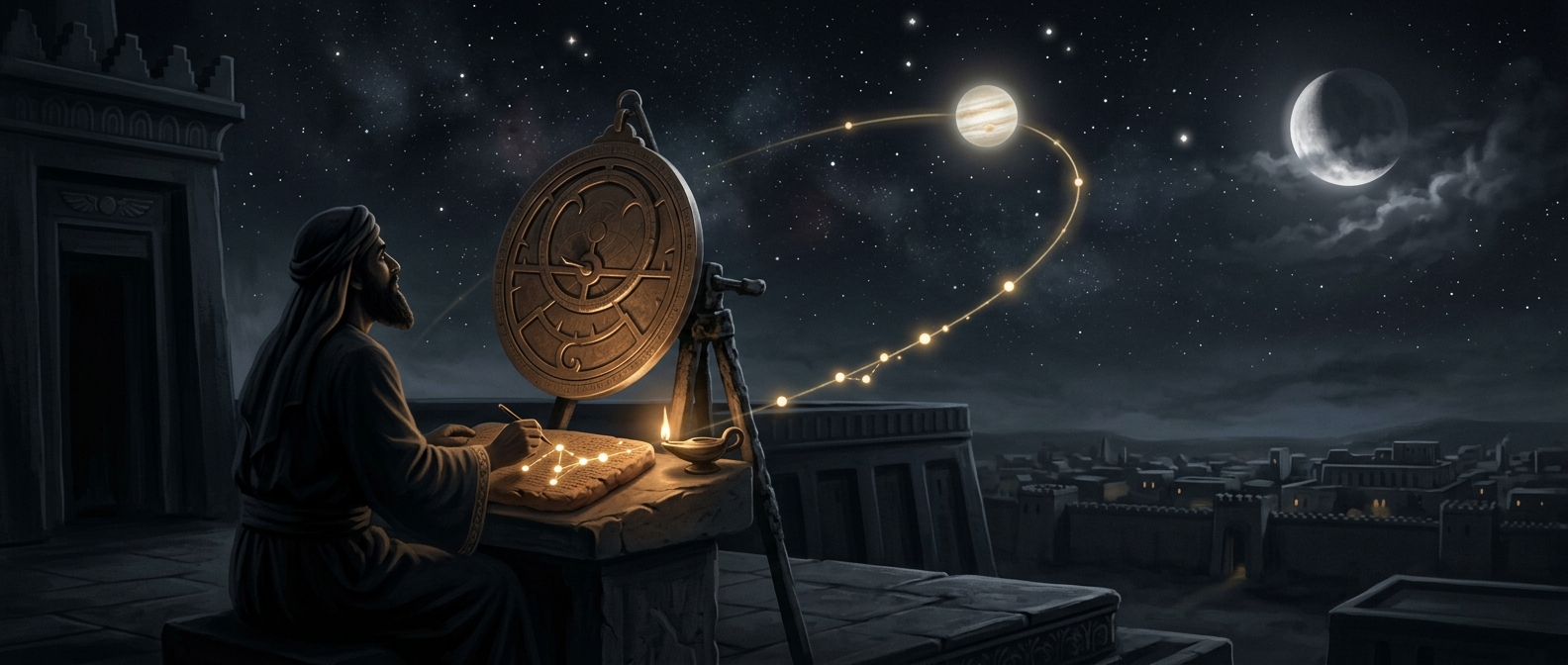
Babylonian observers pressed notes about Jupiter’s position into soft clay with reed styluses. Each tablet preserved a snapshot that could be compared with later ones. The clay was a practical medium for keeping records: once it dried, the marks remained available for reference rather than depending on someone’s memory of the sky.
From sightings to a pattern
The crucial step was repetition. When observers recorded where Jupiter appeared in relation to familiar stars, the entries became a timeline. Comparing them made changes in its position visible, including the stretches when it moved slowly or appeared to turn back. That apparent reversal is an effect of viewing the planets from a moving Earth, not Jupiter actually reversing its orbit.
Over time, accumulated observations could support more than description. They gave astronomers material to recognize recurring behavior and anticipate where Jupiter would appear again. The tablets therefore linked careful watching to practical prediction: the sky became something that could be checked against a record and examined for regularities.
Why the tablets mattered
A written observation outlasted the night on which it was made. It could be revisited and set beside another observer’s entry, allowing knowledge of a slow-moving planet to build across many nights. The important instrument was not only the stylus or the tablet, but the growing sequence of comparable observations.