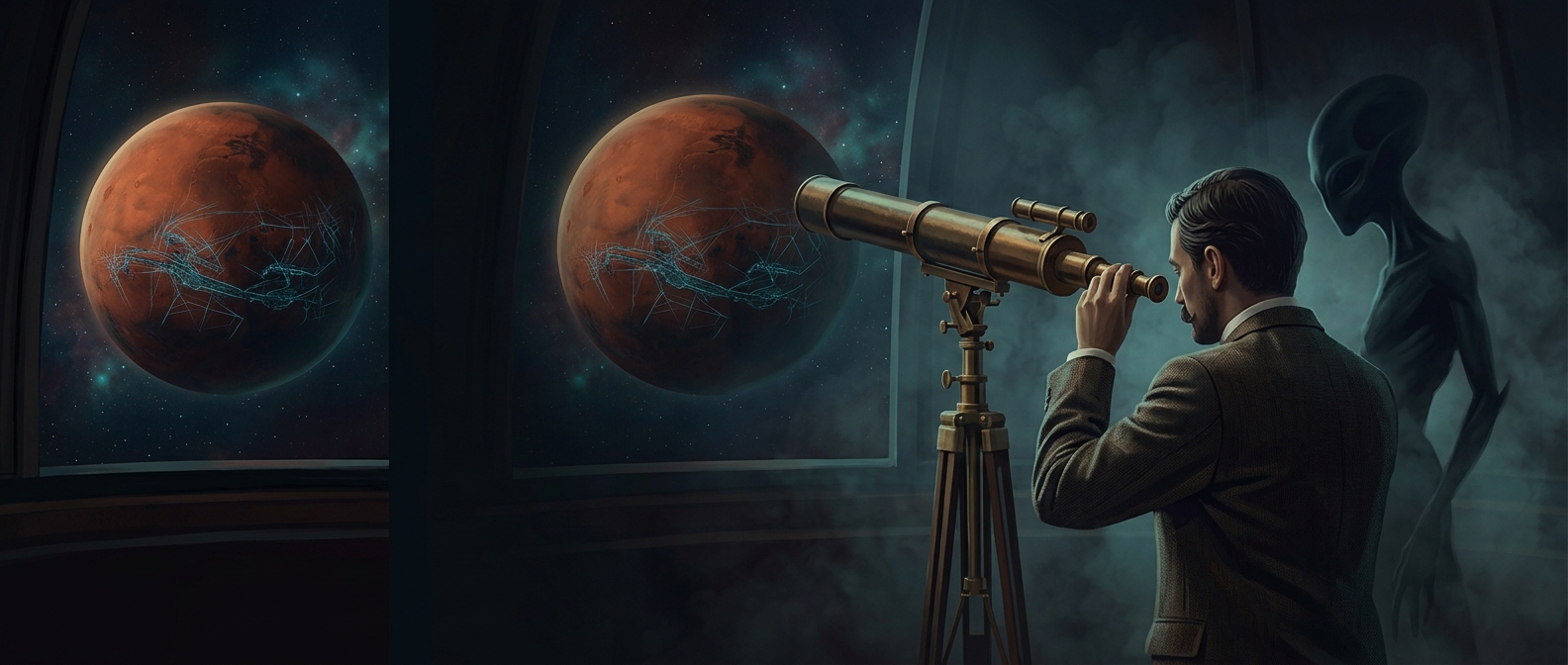
One English word changed the picture
When Giovanni Schiaparelli described markings he saw on Mars in the 1870s, he called them canali. In Italian, the word can mean channels: formations through which water might flow, whether made by nature or by people. English readers often encountered it as “canals,” a term that more readily evokes engineered waterways.
That shift did not prove that the lines were artificial, and Schiaparelli’s word alone did not create the idea of Martian builders. But it made a natural-looking observation easier to read as evidence of design. Once the lines were imagined as construction, the next question seemed to be who had built them.
From a visual mark to a civilization
Astronomers were observing Mars through telescopes that could not resolve its surface in fine detail. Faint, blurred features could be difficult to distinguish, and observers sometimes interpreted indistinct markings as long, straight lines. The translation gave those apparent lines a suggestive name; later enthusiasts, especially American astronomer Percival Lowell, treated them as a vast network of waterways and argued that intelligent inhabitants had made them.
The idea caught public attention because it joined a real astronomical observation to a compelling story: a dry planet’s inhabitants might be moving water to survive. As better observations failed to confirm a planet-spanning canal system, that interpretation lost ground. Yet the episode shows how a small linguistic choice can shape what people think they are seeing: “channel” leaves nature in the frame, while “canal” quietly invites an engineer into it.