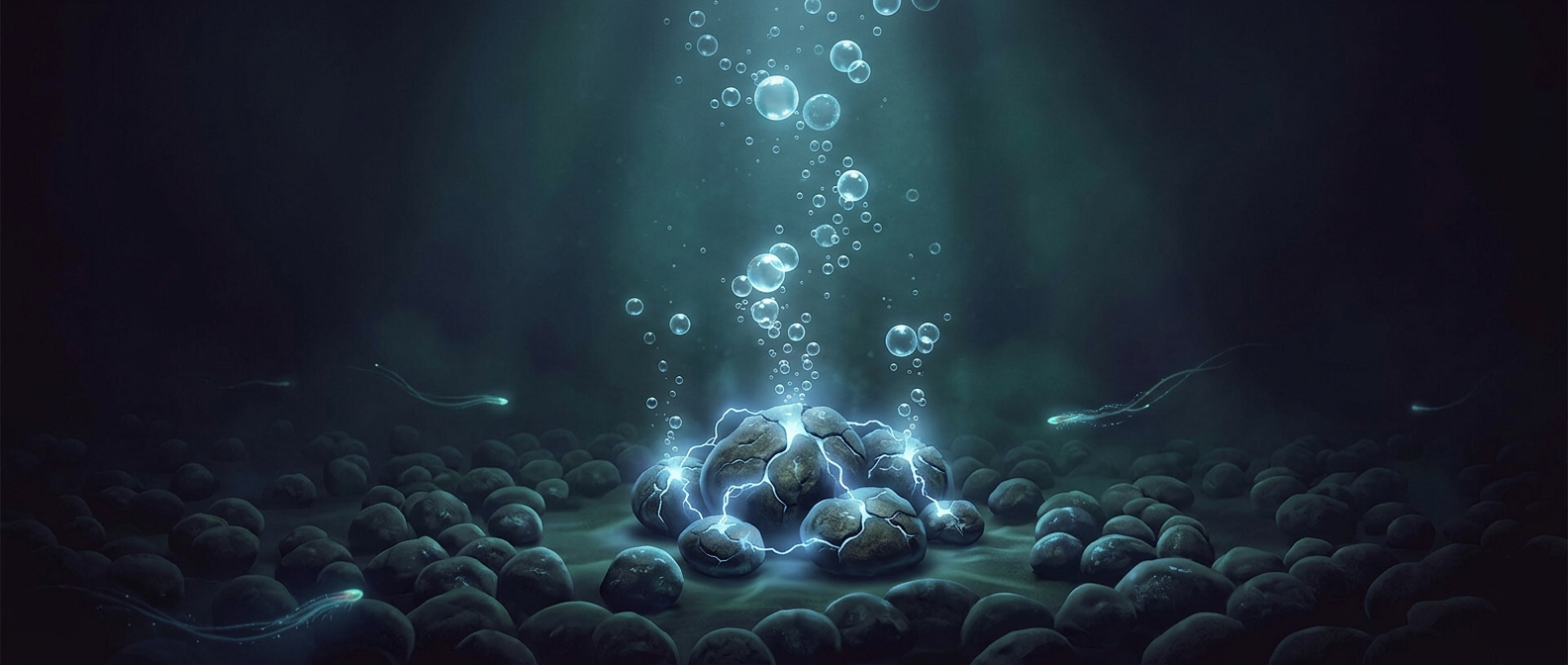
How a rock could act like a tiny power source
Many deep-sea mineral nodules grow in layers of metal-rich minerals on the ocean floor. Different minerals can have different electrical properties. The proposed mechanism is that contrasts across a nodule’s surface create a small voltage—much like the two sides of a battery—without any sunlight or living machinery.
If that voltage is strong enough, it could drive chemical reactions at the rock–water boundary. In electrolysis, electrical energy pulls water molecules apart, producing hydrogen and oxygen. The nodule would not be storing sunlight; it would be supplying energy through its own mineral chemistry.
Why the explanation is difficult to establish
A voltage measured on a rock does not by itself prove that it is splitting seawater. Researchers would need to show that the voltage persists under deep-sea conditions and that the resulting reaction actually produces oxygen. Seawater contains dissolved salts and other chemicals that can take part in competing reactions, so detecting a change in oxygen is not the same as identifying exactly how it formed.
That distinction matters on the dark seafloor, where oxygen is usually associated with processes ultimately powered by sunlight, such as photosynthesis near the ocean surface. If nodules generate oxygen chemically, they could provide an additional source in places far below the reach of light. But measurements and proposed mechanisms have not settled whether this happens naturally at a meaningful rate.
The test is more than finding oxygen
The key evidence would connect the whole chain: a natural voltage across the mineral surface, a reaction that splits water, and oxygen produced as a result. Until that link is established, the battery-like explanation remains a plausible idea rather than a confirmed account of seafloor oxygen. The striking possibility is that a patch of dark ocean floor could host a chemical energy source built into the rocks themselves.