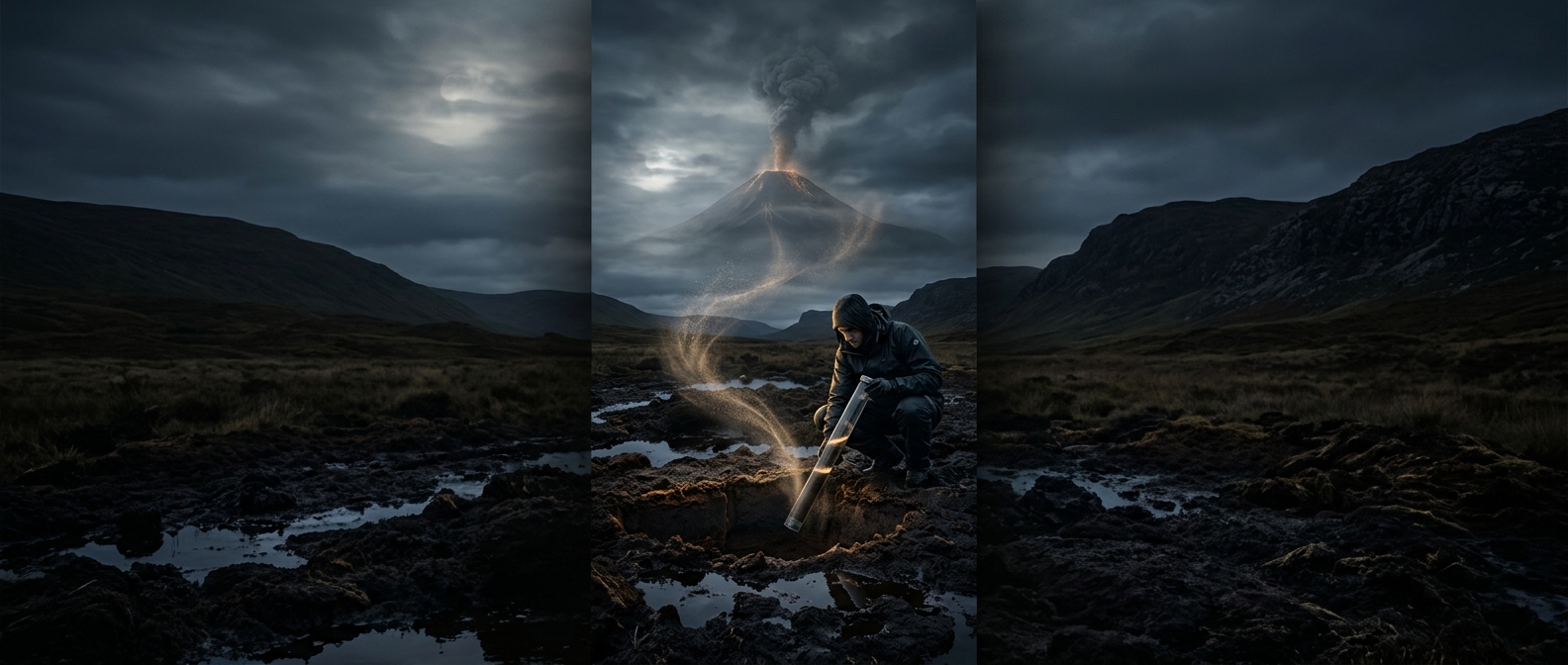
How Vesuvius ash reached Scottish peat
A volcano does not have to be nearby for its ash to leave a trace. During an explosive eruption, magma is blasted into fine particles that can rise high into the atmosphere. Winds carry some of them far from the volcano before they settle onto land or water. If ash from Vesuvius reached Scotland, the visible dust could disappear over time while durable fragments of volcanic glass remained in the bog.
Glass shards act like a chemical fingerprint
Volcanic glass forms when molten material cools too quickly for crystals to grow. Its shards may be microscopic, but their chemistry reflects the magma from which they formed. Researchers can analyze the elements in individual particles and compare that pattern with material from known eruptions. A close match can identify the ash’s volcanic source more precisely than appearance alone.
A thin layer can anchor a bog’s timeline
Peat builds up as plant remains accumulate faster than they decay in waterlogged ground. The layers preserve pollen, plant material, and other particles from different periods. When researchers find volcanic ash within those layers, it can provide a time marker: material just below the ash was deposited earlier, and material above it later.
That marker helps researchers compare records from different places and place nearby changes—such as shifts in vegetation—within a broader timeline. The ash is useful not because it is abundant, but because a chemically identifiable event can pin a small slice of peat history to a particular eruption.