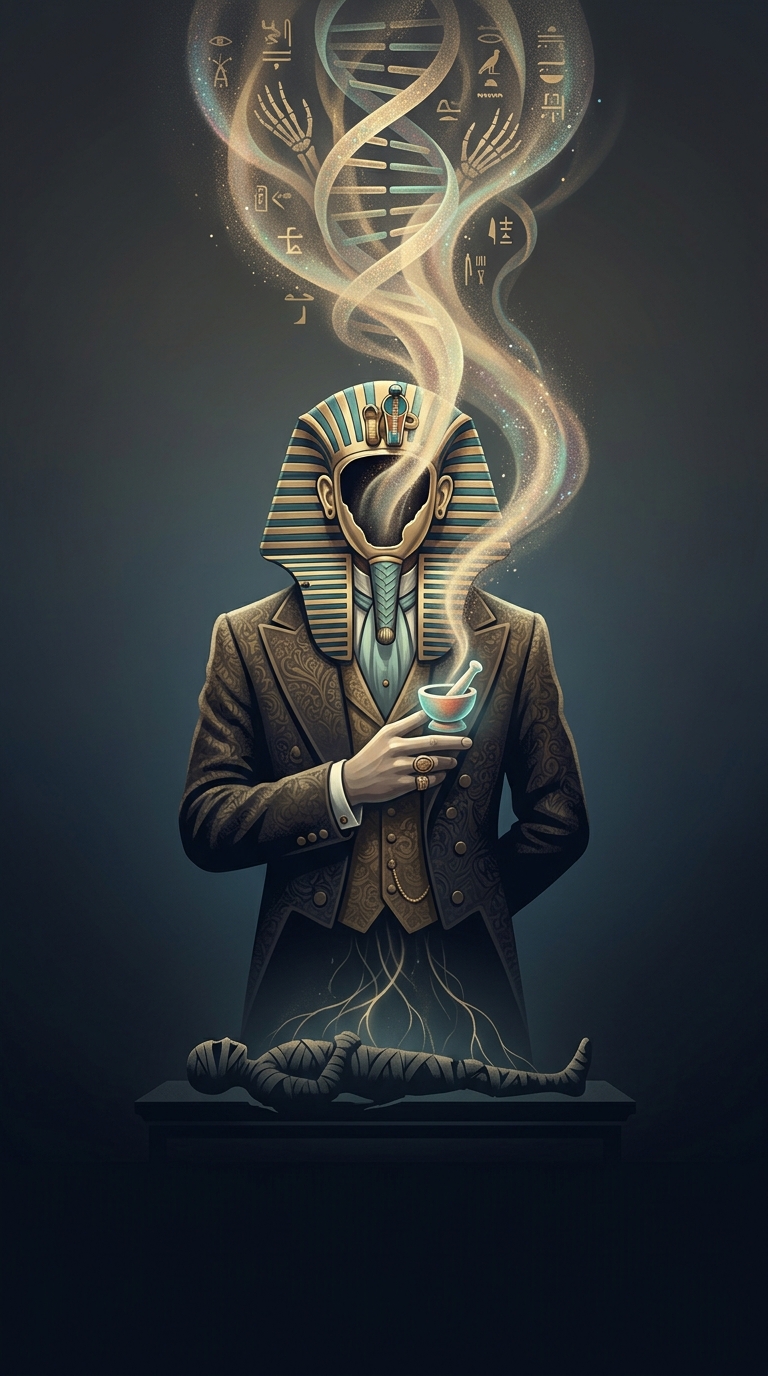
A mummy could become an evening’s spectacle
For some wealthy Victorians, owning an Egyptian mummy meant more than displaying a wrapped body as an exotic curiosity. The wrappings might be removed before an audience. These “unrollings” took place at private gatherings as well as public demonstrations, where guests watched layers of linen come away and the body beneath was exposed.
The event mixed entertainment with the language of scholarship. A surgeon or antiquarian might describe the wrappings, amulets, and remains as they were revealed, treating the mummy as evidence about ancient Egyptian burial customs. But the procedure was destructive: once the bandages were cut or pulled apart, the original arrangement—and often the objects tucked inside—could not simply be restored.
Curiosity, investigation, and possession
The unwrapping reflected a Victorian belief that the past could be made physically accessible through collecting and examination. An Egyptian burial was recast as a specimen to study and a spectacle to witness. That combination helps explain why a gathering could be presented as serious inquiry while still drawing its appeal from the drama of seeing a dead person uncovered.
Not every imported mummy was unwrapped, and the practice was not an ordinary household routine. Many remained intact in collections. Still, for owners and audiences who did take part, the encounter was startlingly direct: a person buried for an ancient ritual could be turned, centuries later, into both an object of study and the centerpiece of an evening’s entertainment.