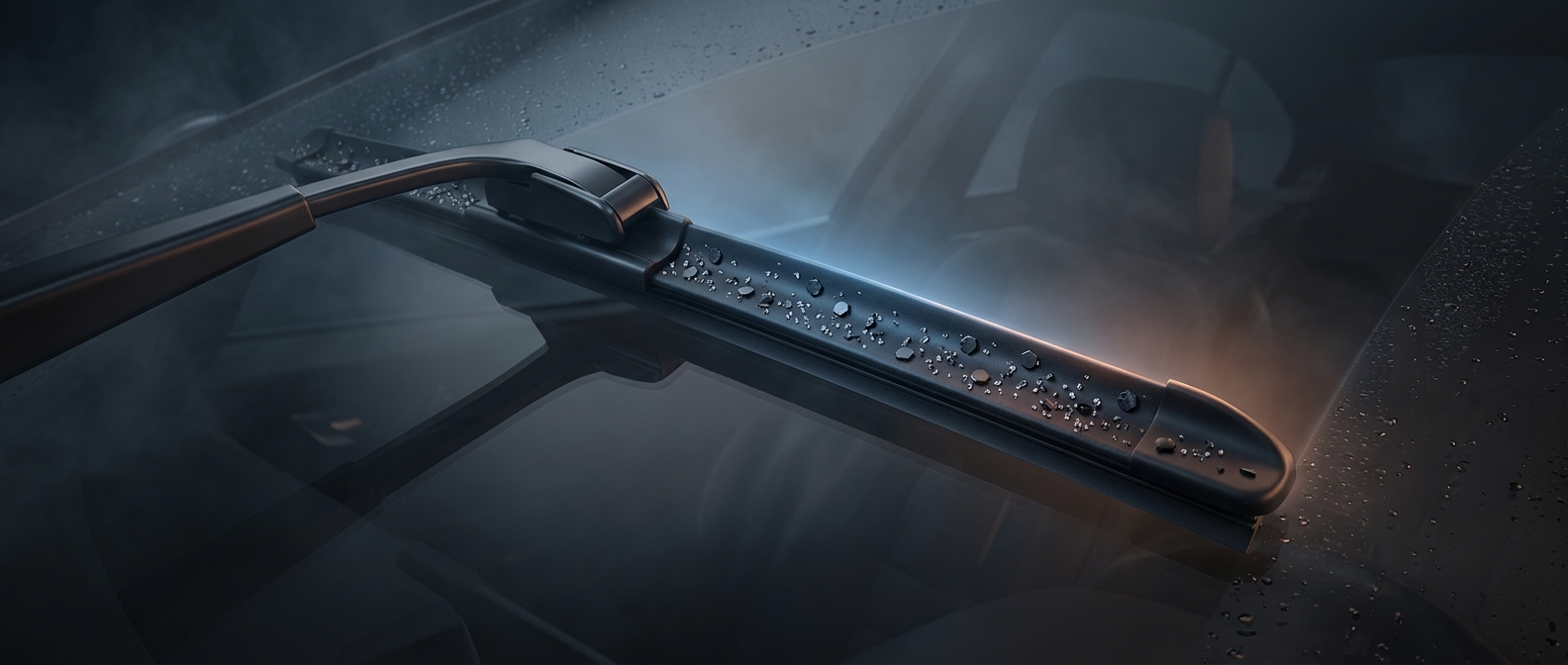
Why a Wiper Blade Needs More Than Rubber
A wiper has to press firmly enough to sweep water off the windshield, but that pressure also creates friction. Bare rubber can catch on tiny irregularities in the glass, then release as the blade moves. That repeated sticking and slipping can produce squeaks or chatter, especially when the glass is only partly wet.
Some blades use graphite-treated rubber to reduce that friction. Graphite is a form of carbon whose thin layers can slide over one another, so it works as a dry lubricant rather than an oily liquid. As the blade travels across the glass, graphite at its surface helps the rubber glide more smoothly.
A Small Surface Treatment, Not a Change in the Wiper’s Job
The rubber still supplies the flexible edge that follows the windshield and pushes water aside. Graphite’s role is to make that contact less noisy and less prone to catching; it does not replace the blade’s pressure or turn the windshield into a frictionless surface. Because the treatment is associated with the rubber, it can help during the blade’s repeated back-and-forth strokes without requiring a separate lubricant on the glass.
That matters in an ordinary driving moment: when rain thins to a mist, the blade may no longer ride on a broad sheet of water, and rough movement becomes easier to hear. A low-friction edge helps keep that sweep quieter while still clearing the driver’s view.