A one-way system hiding in plain sight
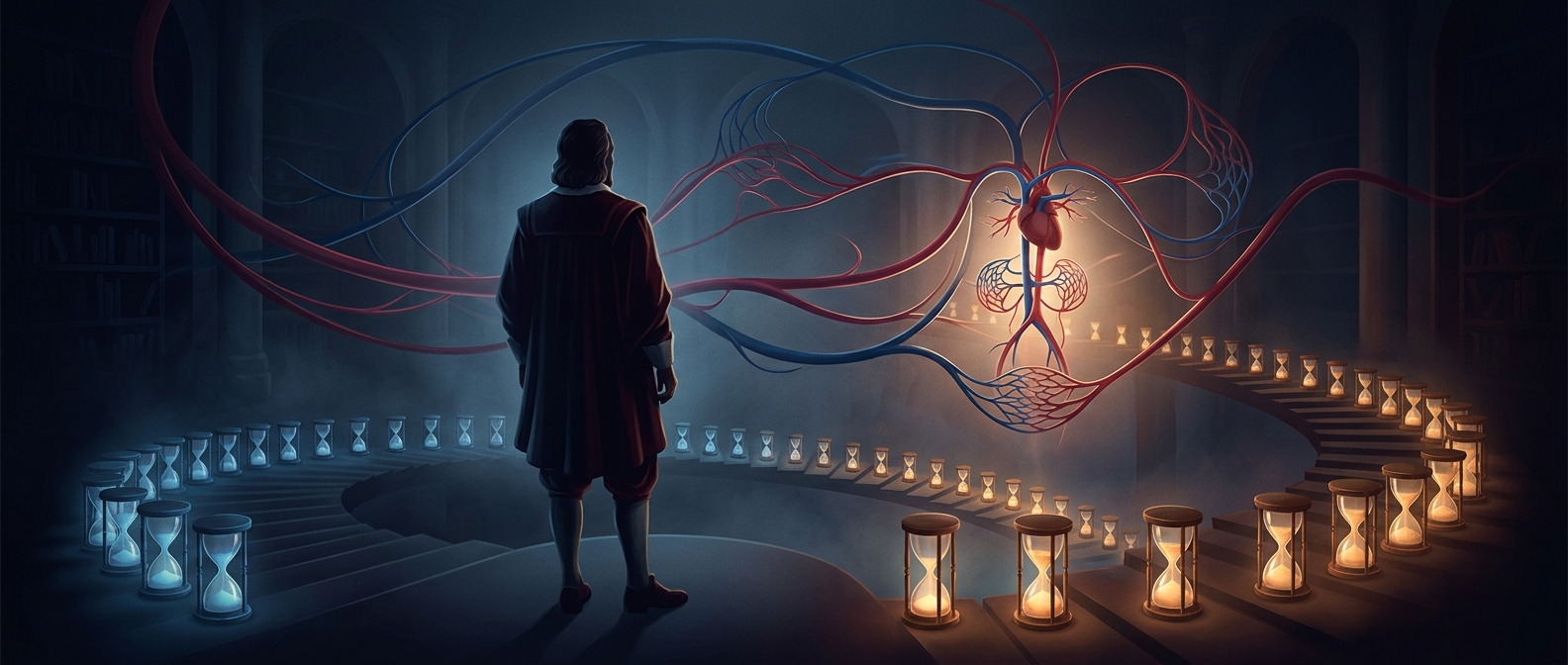
Harvey’s case began with a puzzle about quantity. The heart sends blood out with every beat, but the body could not continually manufacture and consume the enormous amount that would require. If blood was not being used up, he reasoned, it had to return and travel around again.
He paired that argument with close observation. Small flaps inside veins—valves—allow blood to move in one direction, toward the heart. Harvey also used simple bandaging experiments: pressure on an arm could make veins swell, and changing the pressure revealed how blood moved through them. Together, the valves and the effects of constriction made circulation something he could infer from the body’s mechanics, not merely from inherited theory.
Why the claim was hard to accept
For centuries, medical teaching had drawn heavily on Galen, whose account treated blood as being produced and used by the body rather than continuously circulating in a closed loop. Harvey’s model reorganized the story: the heart acted as a pump, arteries carried blood away from it, and veins returned it.
That was more than a correction to one anatomical detail. It challenged a framework embedded in medical education, so the argument had to persuade readers who had learned to interpret the body differently. In De Motu Cordis, published in 1628, Harvey laid out observations and reasoning that readers could examine for themselves.
From disputed theory to a new map
Harvey’s work did not make every question about blood disappear; the tiny connections between arteries and veins were too small to see with the instruments available to him. But the circulation model made those connections necessary: blood leaving the heart had to find a route back. Later observation of capillaries supplied the missing link.
The lasting change was a shift in how physicians could explain the body—not as a set of organs continually making and consuming fluids, but as a system in which a pump keeps the same blood moving along a route.