How a Fly Became a Geometry Problem
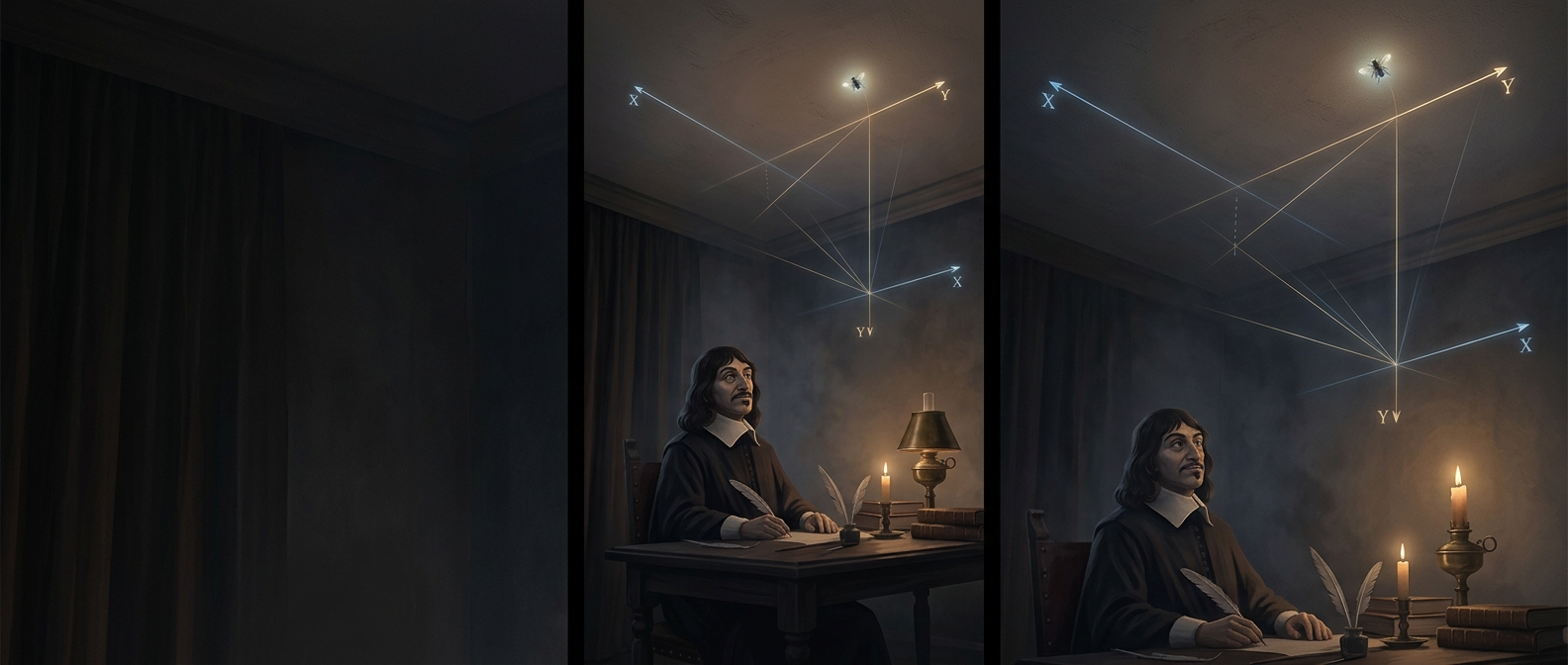
The story of Descartes watching a fly on a ceiling is often told as a moment of mathematical insight. Whether or not that scene happened exactly as remembered, it captures the central move behind analytic geometry: describe a point in space with numbers, then use algebra to reason about its position and motion.
Imagine choosing two reference lines that cross at a right angle. A point can be located by measuring how far it is from each line. Those two distances form an ordered pair: one number for the horizontal direction, another for the vertical. This is the basic idea behind Cartesian coordinates, named for Descartes.
Turning Shapes Into Equations
Once positions have numerical descriptions, geometry and algebra can work together. A circle, for instance, is no longer only a shape to draw; its points can be described by an equation. A moving fly can likewise be represented by a changing pair of coordinates. Its path becomes something that can be plotted, compared, and analyzed—not just watched.
The important leap is not the insect itself but the choice of reference. The fly’s location has no useful numerical description until someone decides what to measure from. With fixed axes in place, a seemingly messy crawl across a surface can be translated into a sequence of precise positions.
That translation gave mathematicians a shared language for connecting diagrams to equations. It also made the everyday act of locating something—how far over, how far up—an entry point to a powerful method for studying curves and motion.