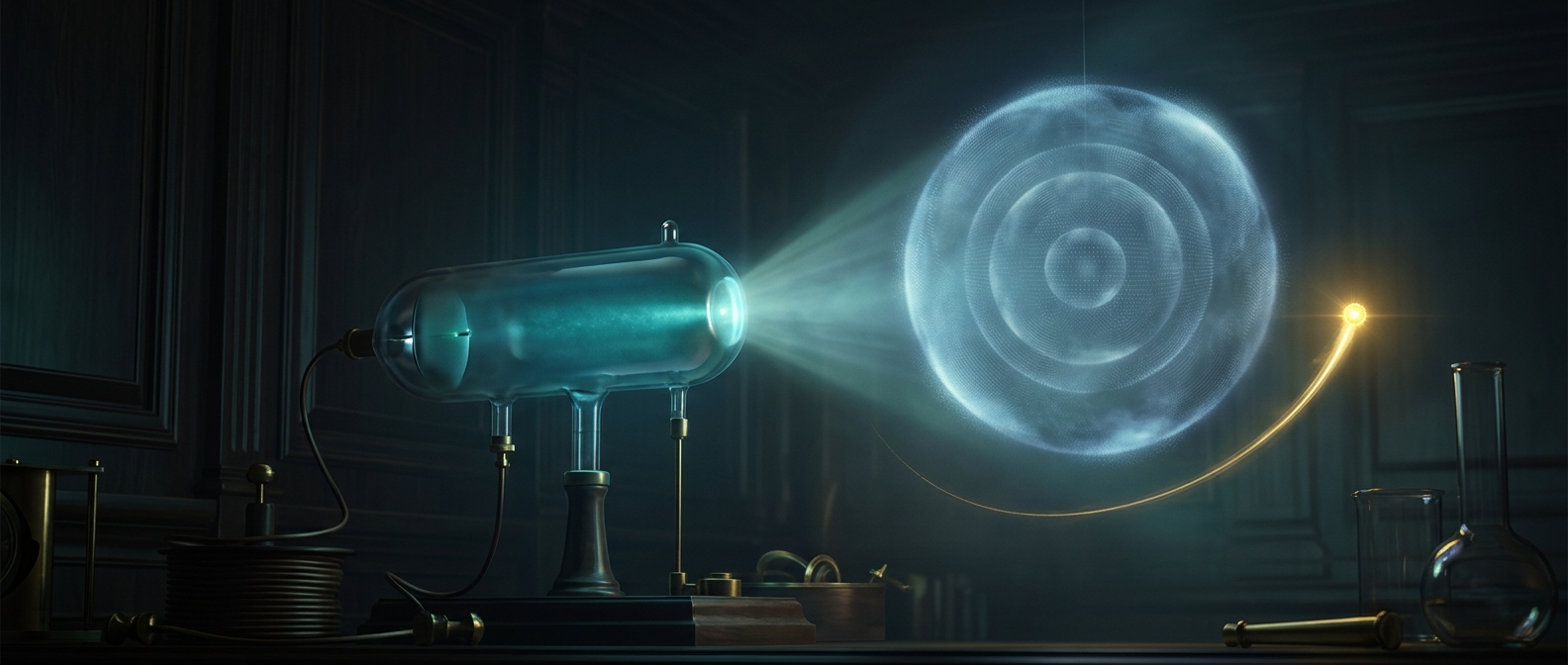
How a glowing tube revealed a hidden particle
Inside an evacuated glass tube, an electric current made a beam emerge from the cathode, the negatively charged electrode. The beam—then called a cathode ray—left a fluorescent patch where it struck the glass. Thomson placed electric and magnetic fields around its path and watched the patch shift.
The direction of the shifts showed that the beam carried negative charge. More importantly, the amount of bending let him compare the particles’ electric charge with their mass. The result pointed to something far lighter than an atom’s known charged constituents. This was not a direct measurement of a particle’s size; it was evidence that the ray was made of tiny, negatively charged pieces of matter.
The same ray, whatever the material
A key clue was that the result did not depend on the metal used for the cathode or the gas left in the tube. If cathode rays had been peculiar fragments of one particular substance, changing those materials should have changed their properties. Instead, the rays behaved as though they were made of the same kind of particle in every case.
That consistency made the implication difficult to avoid: the particles were ingredients of atoms, not atoms themselves. Thomson’s work established the electron as a constituent of matter and overturned the picture of the atom as an indivisible final unit.
A new problem inside the atom
Finding a negative particle raised an immediate question: atoms are usually electrically neutral, so what balanced the electron’s charge? Thomson proposed a model in which negative electrons were embedded in a spread-out positive charge. That model was later replaced, but the deeper change endured. Once atoms had internal parts, their structure—and the way those parts were arranged—became a question that experiments could investigate. A beam that left a bright mark on glass had opened the atom to study.