How a train can climb a 110% grade without tilting its passengers
A 110% slope does not mean the track rises at 110 degrees. It means the railway climbs 110 units for every 100 units it travels horizontally—an angle of about 48 degrees. That is steep enough for an ordinary passenger cabin, fixed to its wheels, to feel more like a tilted room than a train car.
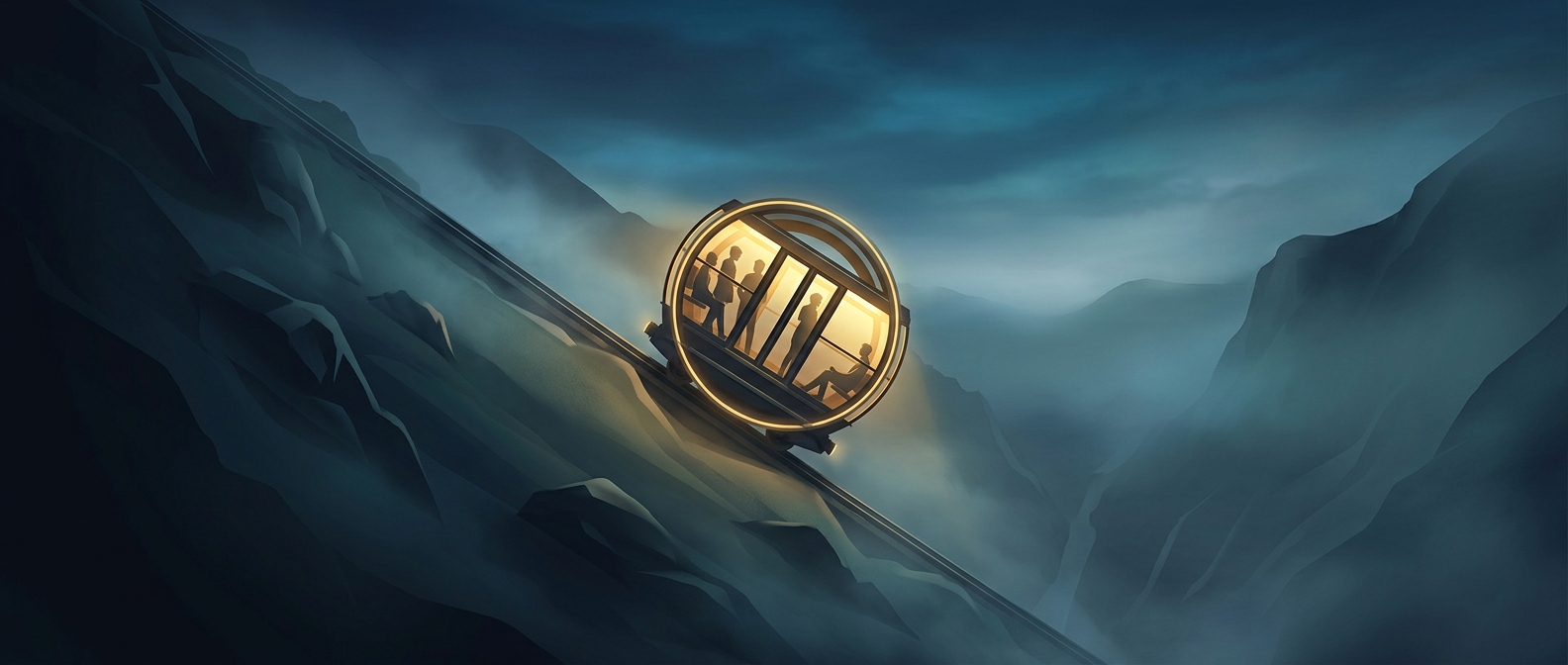
The solution is to let the passenger compartment move independently of the running gear. The chassis follows the rails, while the cabin swivels relative to it as the incline changes. A leveling system continually adjusts the cabin so its floor stays close to horizontal. The train can therefore negotiate a sharp transition from flatter track to a severe climb without forcing riders to stand or sit at the same angle as the rails.
The track can be steep; the ride need not be
This arrangement separates two jobs that conventional railcars combine: the chassis stays aligned with the track, and the cabin stays aligned with gravity. As the railway climbs or descends, the cabin’s orientation changes, rather than the passengers’ sense of balance changing with it.
That distinction makes an unusually steep route practical for passengers, but it does not make the railway operate like a normal train on a steep hill. A funicular is hauled along a fixed, steep track by a cable, and its cars are designed specifically for that route. The swiveling cabin solves the human-comfort problem; the cable railway and its specialized track handle the climb.
The striking result is that the rails can approach a 48-degree angle while the floor inside remains level—a reminder that a vehicle’s body does not have to point in the same direction as the mechanism carrying it.