The first guitars were smaller, four-course instruments
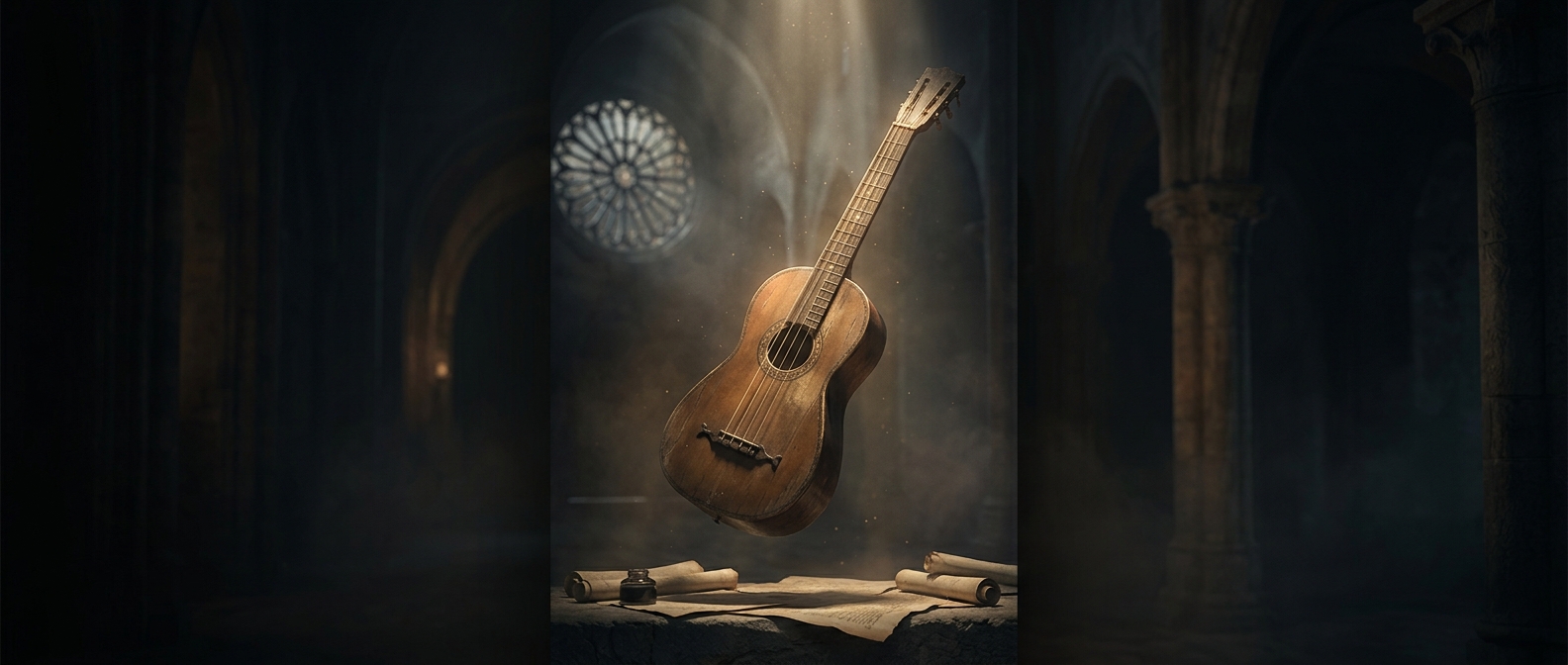
The earliest guitars known from Renaissance Europe did not look or sound quite like the modern six-string guitar. They typically had four courses: four lines of strings running along the instrument. A course could contain one string or a pair tuned together, so “four strings” can be a simplification—the key point is that the instrument had four playable courses.
That arrangement suited the guitar’s role in music of the time. It was a compact instrument for strumming chords and accompanying songs, rather than the long-range, high-volume solo instrument familiar from rock. Its tuning and construction shaped what players could easily play; adding courses later widened the instrument’s available notes.
How four courses became six
During the sixteenth century, a fifth course was added, and the instrument’s range grew. A sixth course followed in the eighteenth century, bringing the guitar closer to the six single strings of the modern instrument. The transition was gradual: older and newer forms existed alongside one another, and paired strings remained common for a time.
The change was not simply a matter of attaching extra strings. More courses meant more notes within reach, especially in the lower register, and encouraged changes in tuning and playing technique. Over time, makers also moved toward six single strings, which made the instrument’s layout more straightforward for melodic playing.
So the familiar six-string guitar is the result of centuries of adaptation, not the instrument’s original design. Its ancestors began with fewer courses—and each addition changed what musicians could do with it.