How a dish of neurons controlled a Pong paddle
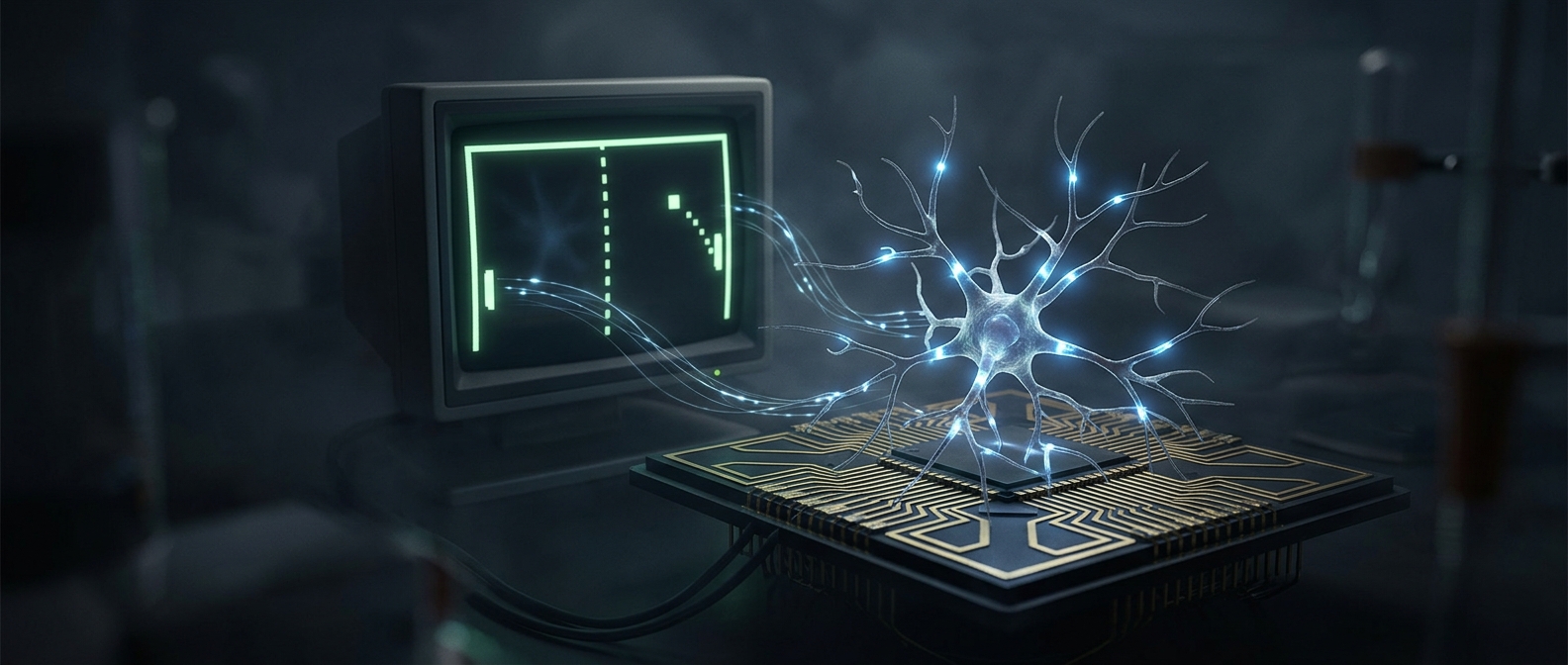
The experiment worked by closing a loop between living cells and a simple video game. Neurons grown on a microelectrode array—a plate that can both stimulate cells electrically and record their activity—received signals corresponding to the moving ball. Researchers read the cells’ outgoing electrical activity and translated it into the paddle’s movement.
That gave the neurons a task with consequences: their activity changed what happened next on screen, and the next ball position changed the signals sent back to them. The cells did not see pixels or know the rules of Pong; the array converted parts of the game into electrical patterns they could respond to.
Feedback gave the cells a way to adapt
A crucial part of the setup was feedback. When the paddle missed, the system supplied a less predictable pattern of stimulation; when the cells’ activity helped return the ball, the feedback was more orderly. That contrast gave the network a signal about whether its recent activity had led to a better outcome.
Neurons naturally change how strongly they signal to one another. Across repeated exchanges, the cultured network’s activity shifted in ways that improved its control of the paddle. This is not the same as learning the game as a person would: the cells had no conscious understanding of a ball, a score, or a goal. Their adaptation emerged from electrical stimulation, recorded activity, and feedback repeated in a tightly controlled loop.
A small but important kind of biological computing
The result showed that living neural tissue could be connected to a digital environment and modify its behavior in response to that environment. It also illustrates the central challenge of such systems: researchers must translate between a biological network’s changing electrical signals and the clear inputs and outputs a computer can use. In this case, that translation was simple enough for a paddle and ball—and concrete enough to reveal learning as a change in the cells’ activity, not just a metaphor.