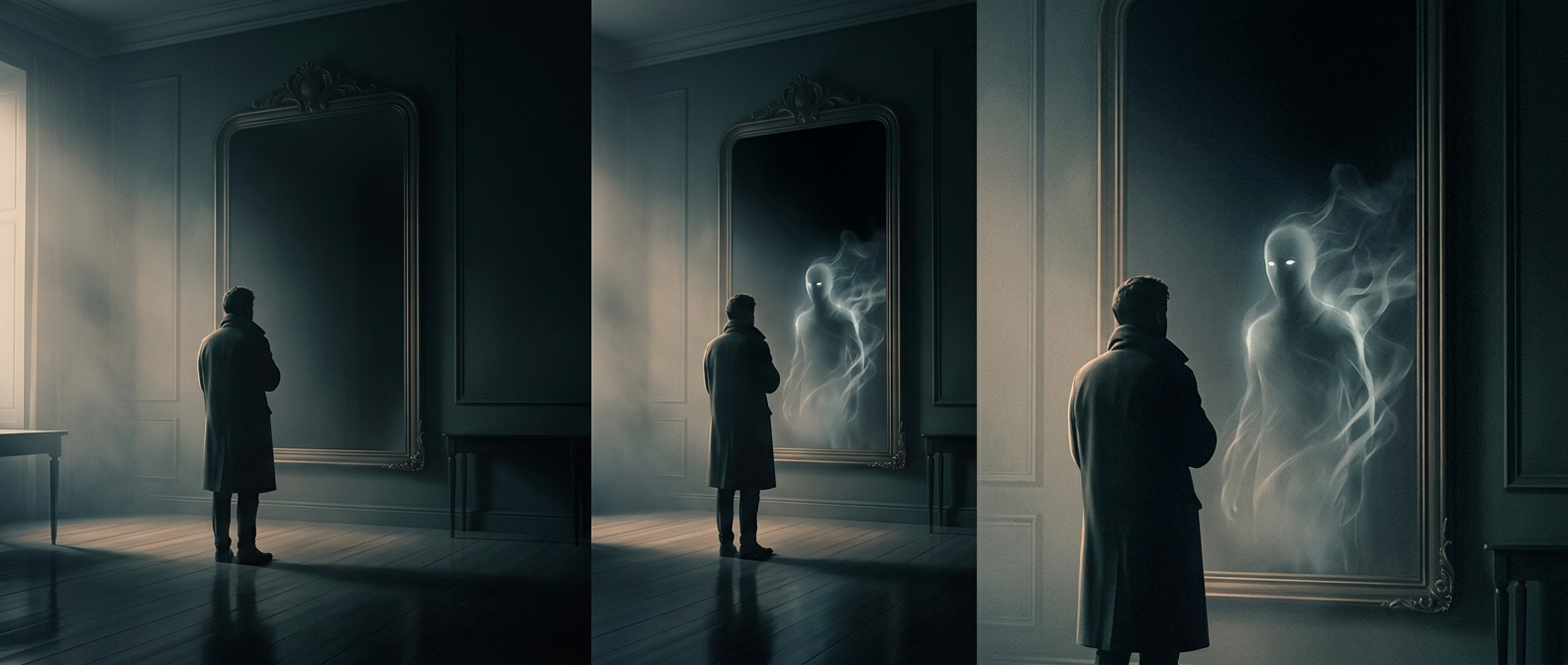
Why an Unclear Shadow Can Feel Like a Ghost
In dim light, the eyes receive less detail. A coat on a chair or a reflection in a dark window may register only as a rough shape, leaving the brain to infer what it is. That process is usually useful: perception combines incomplete visual signals with expectations and past experience to make a quick guess. But when someone strongly fears ghosts, the same uncertainty can make a threatening interpretation feel especially plausible.
Expectation Changes What Gets Noticed
Fear can tune attention toward possible danger. A person may scan a mirror, doorway, or patch of shadow for signs of a figure, while ordinary explanations remain harder to settle on. The result need not be a clear, sustained vision; a fleeting impression or “Was that something?” can be frightening because it arrives before the person has enough detail to check it.
This is not the eyes literally creating a ghost. It is the mind making a rapid interpretation from ambiguous information, with fear influencing which possibility stands out. Turning on a light, changing viewing angle, or looking again can supply the missing detail and reveal a familiar object or ordinary reflection.
Why Checking Can Keep the Fear Alive
Repeatedly checking a mirror may briefly ease anxiety when nothing unusual appears. But the relief can teach the brain that checking was necessary, making the next uncertain shadow feel worth inspecting too. The mirror becomes less a source of information than a place where the person expects to find danger.
That helps explain why the most unsettling moment may happen before anything is clearly seen: in the gap between a vague shape and the explanation the mind fears.